Skip to header Skip to main navigation Skip to main content Skip to footer

Search form

Home
Eagle Nest New Mexico
Where the Mountains Meet the Lake

Main navigation

  • Home
  • Dining
  • Lodging
  • Shopping
  • Things to Do
  • Outdoors
  • History
  • Webcams
  • Business Directory

Eagle Nest Dam

The Hands That Raised the Arch: Taos Pueblo Laborers Built Eagle Nest Dam
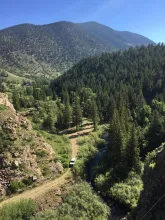
View from Eagle Nest Dam overlooking the Cimarron River in its canyon below the dam, photographed in July 2017.

Did you know that the great concrete arch at the head of Cimarron Canyon was raised, bucket by bucket, largely by laborers from Taos Pueblo? The dam that created Eagle Nest Lake carries the names of Frank and Charles Springer, the ranchers who won Permit No. 71 in 1907 and financed the project through the Cimarron Valley Land Company. The work itself, however, belonged to the crews who lived beside the canyon and built the structure with their hands. Local history records that most of the labor for building the dam was provided by the Taos Pueblo people.
  • Read more about The Hands That Raised the Arch: Taos Pueblo Laborers Built Eagle Nest Dam

Fifty Miles Downstream: How Eagle Nest Water Reaches the Fields

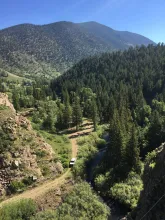
View from Eagle Nest Dam overlooking the Cimarron River below the dam, where outflow from the lake is measured.

When you stand at Eagle Nest Lake State Park and look east, the water in front of you is only at the start of its working journey. The lake was built to store the surplus and flood flows of the Cimarron River, and the water it holds was never meant to stay in the Moreno Valley. Released through the gated outlet works of Eagle Nest Dam, it enters the Cimarron River in its narrow granite canyon and begins a trip that can carry it fifty miles downstream to the farms and ranches it was promised to more than a century ago.

  • Read more about Fifty Miles Downstream: How Eagle Nest Water Reaches the Fields

Thirty Years Before the Water Rose: The Long Wait for Eagle Nest Lake

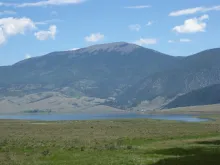
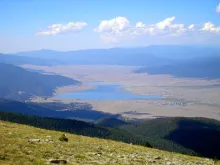
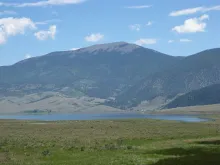
Eagle Nest Lake seen across the grassland of the Moreno Valley floor, with a forested mountain rising behind the water.

When you stand on the shore at Eagle Nest Lake State Park, the water looks as if it has always belonged here. The lake spreads about five miles long and two miles wide across the Moreno Valley floor, its surface sitting at 8,172 feet when full, beneath Wheeler Peak and Baldy Mountain. Yet this lake was imagined for thirty years before the water rose, and the valley floor it covers was working farmland whose owners did not give it up easily.

  • Read more about Thirty Years Before the Water Rose: The Long Wait for Eagle Nest Lake

Thin at the Top, Strong in the Curve: How Eagle Nest Dam Holds the Lake

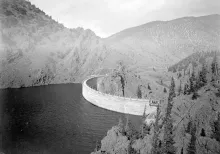
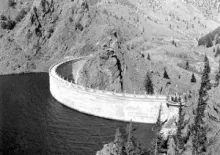
Historic black-and-white photograph of the curved concrete arch of Eagle Nest Dam holding back Eagle Nest Lake between granite canyon walls.

From the shoreline at Eagle Nest Lake State Park, the water looks calm and natural, as if the Moreno Valley had always held a lake. The reason it stays here sits hidden in a narrow canyon just east of the village, where Eagle Nest Dam curves across the Cimarron River. The crest of the dam is only 9.5 feet thick, yet it holds back a reservoir of 79,120 acre-feet. Its strength does not come from thickness. It comes from its curve, which pushes the weight of the lake into the granite canyon walls on either side.

  • Read more about Thin at the Top, Strong in the Curve: How Eagle Nest Dam Holds the Lake

Stone, Granite and Cyclopean Concrete: How Eagle Nest Dam Leans on Its Canyon

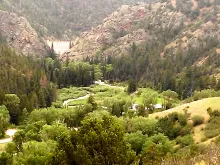
The Cimarron River valley below Eagle Nest Dam, with the dam face visible between the granite canyon walls in the distance.

Did you know that Eagle Nest Dam holds back Eagle Nest Lake not by brute weight alone, but by leaning into the canyon itself? East of the village, where the Cimarron River leaves the Moreno Valley, the river squeezes through a narrow gorge of red granite and porphyry. Before construction began, the National Register nomination recorded, that canyon measured only 40 feet wide at its base and 350 feet at the top. It was exactly the kind of tight, hard-rock slot an arch dam is made for, and the builders used every inch of it.

  • Read more about Stone, Granite and Cyclopean Concrete: How Eagle Nest Dam Leans on Its Canyon

Still Working After a Century: Eagle Nest Dam as Living History

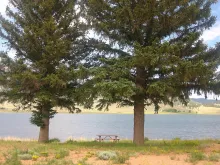
Eagle Nest Lake seen across the grassy Moreno Valley floor, its blue water backed by forested mountain slopes under a summer sky.

Some landmarks you visit behind a rope. Eagle Nest Dam is not one of them. More than a century after Taos Pueblo laborers raised its concrete arch in Cimarron Canyon, the dam is still on duty every day, holding back the Cimarron River to form Eagle Nest Lake and releasing water for the farms and ranches it was built to serve. Frank and Charles Springer and the Cimarron Valley Land Company received Permit No. 71 in 1907, and construction ran from 1916 to 1918.

  • Read more about Still Working After a Century: Eagle Nest Dam as Living History

The Railroad That Never Reached Eagle Nest: A Tunnel Above the Dam

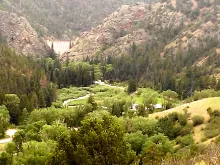
The Cimarron River winds through its forested canyon below Eagle Nest Dam, whose pale concrete face shows between the granite walls in the distance.

Did you know that no train has ever rolled into Eagle Nest? The Moreno Valley came tantalizingly close to a railroad in the first years of the 1900s, and the effort left a permanent mark on Cimarron Canyon: a tunnel cut through solid rock above the site of Eagle Nest Dam, bored for trains that never came. The story begins not in the valley, but in the coal country around Raton.

  • Read more about The Railroad That Never Reached Eagle Nest: A Tunnel Above the Dam

The Eagles on the Concrete: How Eagle Nest Dam Got Its Name

A black-and-white photograph from 1922 showing the curved concrete arch of Eagle Nest Dam spanning the Cimarron River in Cimarron Canyon.

Drive east from the village on U.S. Route 64 and the road leaves Eagle Nest Lake behind and enters Cimarron Canyon, where a pale concrete arch still spans the Cimarron River between granite walls. That arch is Eagle Nest Dam, the structure that created the lake, and its name carries a story that visitors hear to this day: eagles made themselves at home on the sides of the new dam, and the dam took its name from its first wild tenants.

  • Read more about The Eagles on the Concrete: How Eagle Nest Dam Got Its Name

Living History on the Lake: A Dam Centennial and a Fish Fest That Endures

Eagle Nest Lake spread across the Moreno Valley below Baldy Mountain on a summer day.

Did you know some of the best history in the Moreno Valley is not behind glass at all? In Eagle Nest, the past stays alive because people keep gathering around it — touring the great concrete dam in Cimarron Canyon, paddling the lake it created, and sitting down together each fall for a fishing celebration that began in the 1930s. This is living history, Eagle Nest style: a working landmark, still doing its job, and a community that celebrates it out loud.

  • Read more about Living History on the Lake: A Dam Centennial and a Fish Fest That Endures

From Fields to Faucets: How Eagle Nest Water Learned to Serve Towns

Another view of Eagle Nest Lake shoreline, New Mexico

When work began on Eagle Nest Dam in 1916, the water behind it had one main job: irrigation. Rancher and entrepreneur Charles Springer, working with engineer Neal Solvangen, built the dam on the Cimarron River to capture surplus flows that otherwise rushed past the Moreno Valley in spring. To help finance the project, Springer sold water rights from the new reservoir to local farmers, and those original deeded rights became known as the vested rights. The lake that filled behind the dam, at about 8,300 feet in elevation, can hold almost 70,000 acre-feet of water.

  • Read more about From Fields to Faucets: How Eagle Nest Water Learned to Serve Towns

Pagination

  • Page 1
  • Next page ››
Subscribe to Eagle Nest Dam

Eagle Nest, NM Weather

Loading current conditions...

Loading forecast...

Upcoming Events

🎉 Eagle Nest Events Calendar

Annual Favorites:
Fourth of July Parade, Barbecue, and Fireworks over the Lake
High Country Arts Festival — Late July, Enchanted Eagle Park
BalloonFest over Eagle Nest Lake
Fish Fest and Pike Round-Up — September, Eagle Nest Lake State Park

Article Archive

Browse past articles