
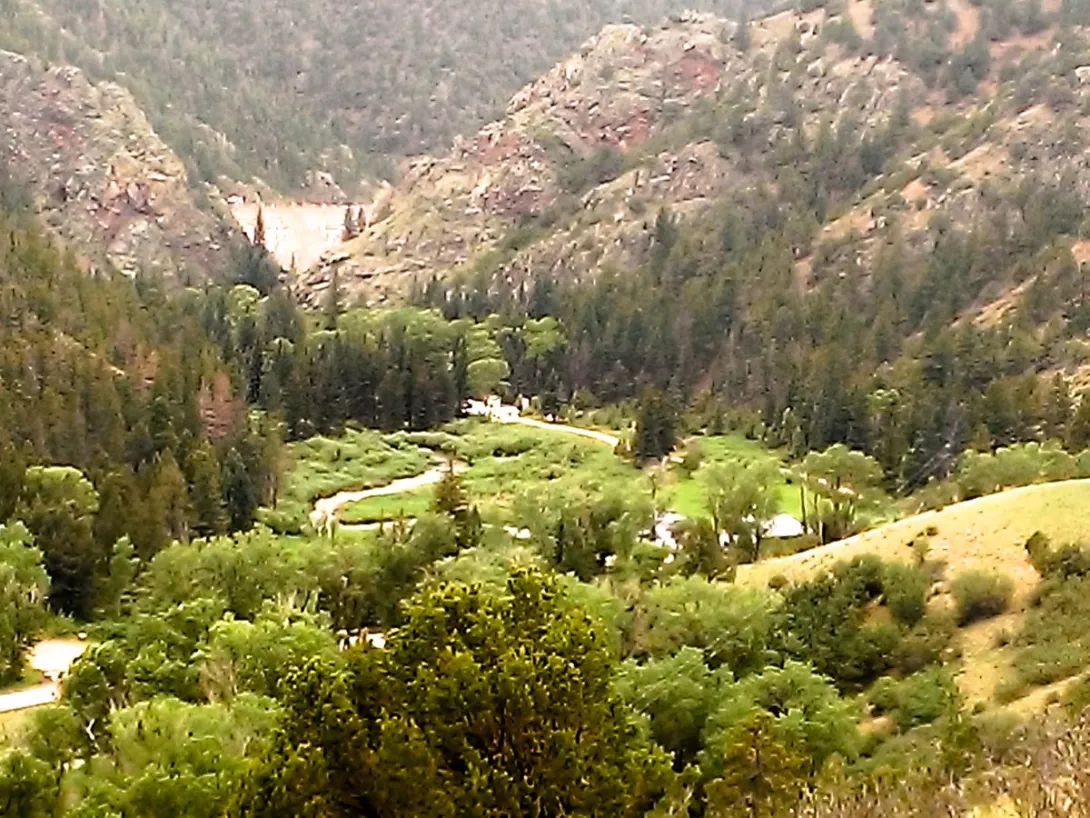
Did you know that Eagle Nest Dam holds back Eagle Nest Lake not by brute weight alone, but by leaning into the canyon itself? East of the village, where the Cimarron River leaves the Moreno Valley, the river squeezes through a narrow gorge of red granite and porphyry. Before construction began, the National Register nomination recorded, that canyon measured only 40 feet wide at its base and 350 feet at the top. It was exactly the kind of tight, hard-rock slot an arch dam is made for, and the builders used every inch of it.
Click to see more photos of Eagle Nest Dam and Eagle Nest Lake
The dam is a masonry structure built of cyclopean concrete, curved on its upstream face to a radius of 155 feet, so the pressure of the stored water is carried sideways into the granite walls. The nomination put the masonry in the structure at 26,000 cubic yards, measured the crest at 286 feet long, and found the dam standing 120 feet above the lowest point of its foundation, 10 feet thick at the crest and 52 feet thick at the base, with a capacity of 78,000 acre-feet. Those figures describe a comparatively slender wall doing its work through shape and stone, not sheer bulk.
Getting that concrete into the gorge was an engineering puzzle in itself. Construction required a trestle running between the concrete batching plant below the site and a 65-foot boom at the dam site. The spillway was not poured but carved, created through the excavation of 16,000 cubic yards of granite on the left side of the reservoir. On the right side, the outlet works were set directly into granite rock: a shaft equipped with gates, with one outlet tunnel and three inlet tunnels to control how stored water left the lake.
The project had been years in the making. The nomination records that Charles Springer purchased a 600-acre dam site from the Maxwell Land Grant Company in 1906, and the dam was conceived and largely financed by Springer, one of the county's early settlers. Built between 1916 and 1920, with Willis Ranney as chief engineer and Neal Hanson as construction superintendent, it was designed to store Cimarron River water for the irrigation of more than 40,000 acres of land in eastern Colfax County.
That is why historians of engineering singled the dam out. The nomination called it significant as one of the oldest functioning arch-type dams in New Mexico built as part of a privately financed irrigation project, and it was listed on the National Register of Historic Places on April 18, 1979. More than a century after its major work, the same curved wall still stores the river behind it, still sends water downstream through the Cimarron and its canals, and still reminds every driver who glimpses it in the canyon that the Moreno Valley's lake was engineered, not found.