Did you know that no train has ever rolled into Eagle Nest? The Moreno Valley came tantalizingly close to a railroad in the first years of the 1900s, and the effort left a permanent mark on Cimarron Canyon: a tunnel cut through solid rock above the site of Eagle Nest Dam, bored for trains that never came. The story begins not in the valley, but in the coal country around Raton.
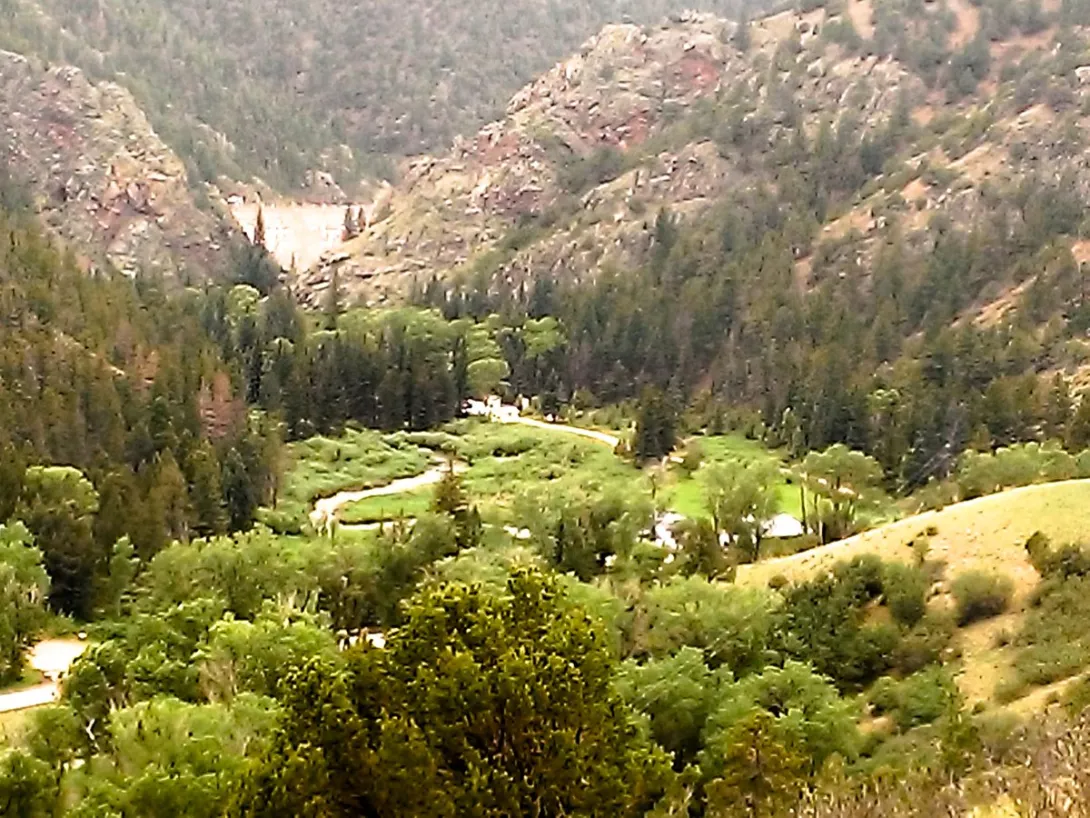
Click to see more photos of Cimarron Canyon and the Cimarron River below Eagle Nest Dam
The St. Louis, Rocky Mountain and Pacific Company was incorporated in New Mexico on June 26, 1905, and it soon formed the Swastika Fuel Company in Raton to mine coal in the area. To make sure its coal and coke traffic had competitive rail service, the company built its own railroad, known as the Swastika Route. Construction began late in 1905, heading south from Raton, and the line crossed the Dawson Railway at Colfax and reached Cimarron in 1906 after laying about fifty miles of track. In 1907 it pushed twelve miles farther west to Ute Park, at the mouth of Cimarron Canyon, which became its western terminus. At its height the system ran about 120 miles of track, coal-mine spurs included, and Cimarron settled into life as a railroad town, with a daily passenger train and ranchers loading livestock for market.
Ute Park, however, was never meant to be the end of the story. The railway planned to extend through Cimarron Canyon, into the Moreno Valley, and on toward Taos. Railroad historian David F. Myrick records that in 1907 the company did grading work on that unfinished extension, including boring a tunnel at the head of the canyon, near the place where Eagle Nest Dam would later rise. It was bold country for a railroad: a narrow granite canyon, a river that flooded, and a high valley waiting on the other side. The extension stalled at the canyon mouth, and no rail was ever laid through it.
A decade later, the railroad's unfinished dream shaped one of the valley's greatest building projects. When Frank and Charles Springer's Cimarron Valley Land Company prepared to build Eagle Nest Dam, the National Register nomination for the dam records that two preparatory jobs had to come first. Because the St. Louis, Rocky Mountain and Pacific still planned to extend into the Moreno Valley, a railroad tunnel had to be cut through the rock above the dam site, and the old road from Ute Park to Elizabethtown and Taos had to be diverted out of the canyon bottom, away from the construction site. Beginning in late 1916, about 150 men worked on that eight-mile project. Only then, in early 1918, did the major work on the dam itself begin.
The railroad era faded quickly after that. The company sold the line to the Atchison, Topeka and Santa Fe Railway on August 1, 1913, and on March 10, 1915, its name was changed to the Rocky Mountain and Santa Fe Railway. Trains kept running to Ute Park for a time, but the Moreno Valley extension was never built, and during World War II the tracks were taken up so the steel could be recycled for the war effort. Today, drivers on U.S. Highway 64 follow the canyon the railroad coveted, past the Palisades and the river, to a lake and a village the trains never reached. The tunnel above the dam site remains the valley's quiet monument to the railroad that almost was.