
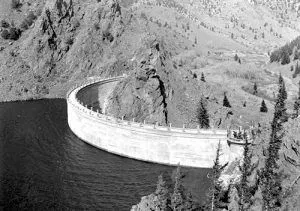
Drive east from the village on U.S. Route 64 and the road leaves Eagle Nest Lake behind and enters Cimarron Canyon, where a pale concrete arch still spans the Cimarron River between granite walls. That arch is Eagle Nest Dam, the structure that created the lake, and its name carries a story that visitors hear to this day: eagles made themselves at home on the sides of the new dam, and the dam took its name from its first wild tenants.
Click to see more photos of Eagle Nest Dam and Eagle Nest Lake
Frank Springer, Charles Springer, and the Cimarron Valley Land Company were granted a water permit in 1907 to impound the Cimarron River for irrigation. Nearly ten years passed before the Springers hired the San Antonio engineering firm of Bartlett and Ranney, whose Willis Ranney is credited as the dam's architect. Construction began in 1916, and most of the labor was provided by workers from Taos Pueblo, who raised the arch in a remote canyon far from any city supply line.
The finished dam was an engineering statement for a private ranching enterprise. It stands 140 feet high with an arc length of 400 feet, measures 9.5 feet wide at the top and 45.2 feet wide at the base, and is considered the largest privately built dam in the United States. Behind it, Eagle Nest Lake spread about five miles long and two miles wide over Moreno Valley pasture, reaching a surface elevation of 8,172 feet when full. Building the dam also forced a change in travel: the Springers had to reroute U.S. Route 64 to its present course over McAvoy Hill.
Local tradition is careful with the eagle story, and so should we be. Legends of America puts it this way: supposedly, eagles built nests on the sides of the new dam, and that is how it got its name. Another account says simply that the dam is named for the eagles that made themselves a home on its sides. However the first nest was spotted, the name stuck to the dam, then to the lake, and in time to the village itself, which had first been called Therma and was renamed Eagle Nest in the 1930s.
History gave the story a formal stamp two generations later. Eagle Nest Dam was designated on the New Mexico State Register of Cultural Properties on January 20, 1978, and added to the National Register of Historic Places on April 18, 1979, recognized for its significance in agriculture, conservation, engineering, and architecture. The State of New Mexico bought the lake in 2002, and the Interstate Stream Commission now operates the reservoir, but the dam still does its original job, sending irrigation water down the Cimarron River and its canals to farmers and ranchers, some as far as 50 miles downstream. The eagles, fittingly, still belong here too.