
Did you know that the great concrete arch at the head of Cimarron Canyon was raised, bucket by bucket, largely by laborers from Taos Pueblo? The dam that created Eagle Nest Lake carries the names of Frank and Charles Springer, the ranchers who won Permit No. 71 in 1907 and financed the project through the Cimarron Valley Land Company. The work itself, however, belonged to the crews who lived beside the canyon and built the structure with their hands. Local history records that most of the labor for building the dam was provided by the Taos Pueblo people.
Click to see more photos of Eagle Nest Dam and Eagle Nest Lake
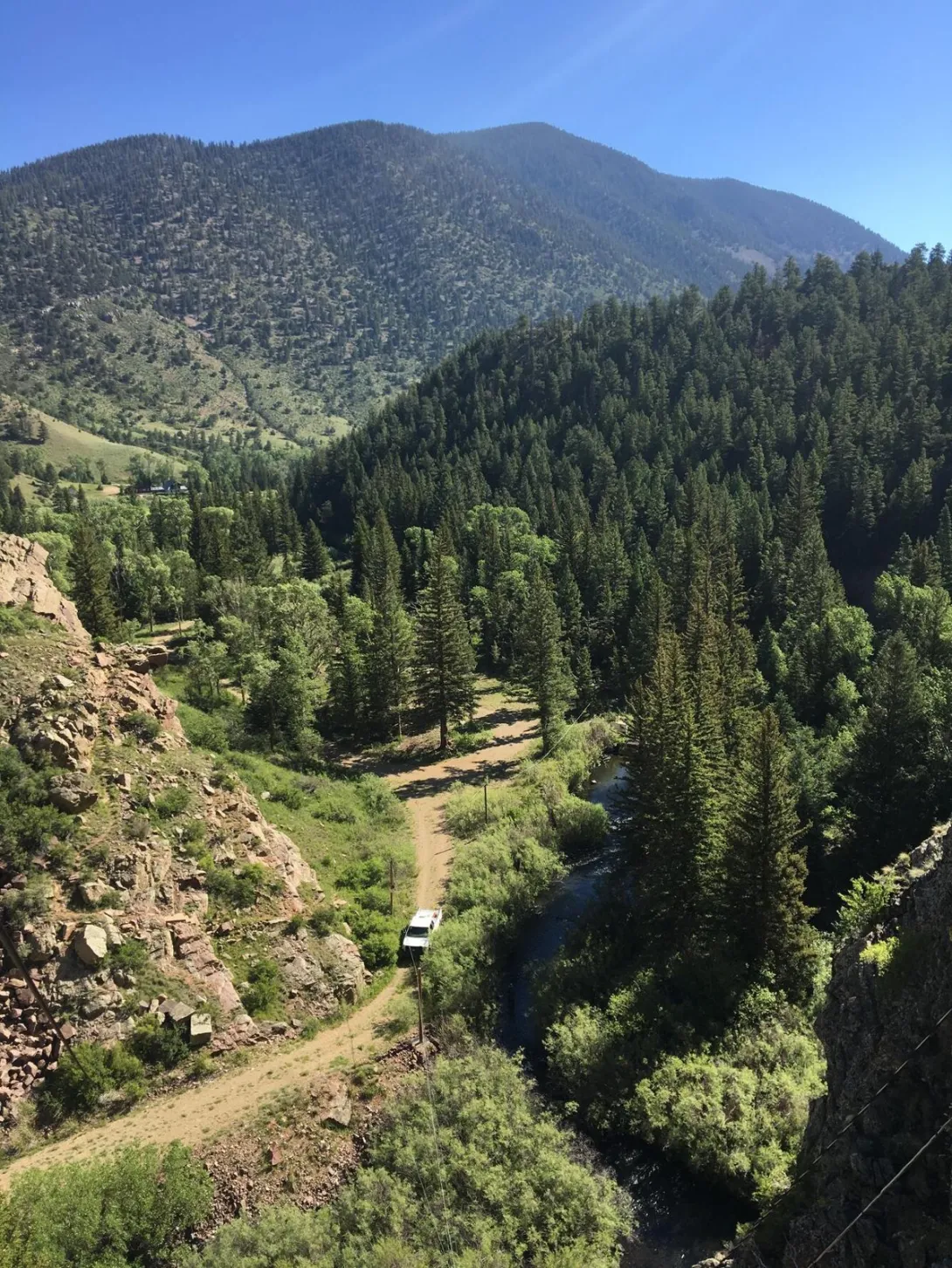
The canyon they had to work in left little room for error. Before construction began, the National Register nomination records that the gorge measured only 40 feet wide at its base and 350 feet at the top, between walls of red granite and porphyry. To keep an open working space, the builders carried the Cimarron River itself over the site in a flume suspended by cables. Because that flume hung above the work, blasting could be done only in small charges, so that the river, the flume, and the men below were all kept safe.
Concrete reached the forms by an equally careful route. A trestle ran between the concrete batching plant below the site and a 65-foot boom at the dam, and the boom lifted the concrete in buckets up to the forms. The San Antonio engineering firm of Bartlett and Ranney designed and built the project, with Willis Ranney as chief engineer and Neal Hanson as construction superintendent. A temporary town beside the canyon housed several hundred laborers recruited from all over New Mexico, and every load of equipment and supplies was hauled in through Cimarron.
The work stretched across hard years. Preparatory work began in late 1916, major construction commenced in early 1918, and the underground work was not completed until 1919, when the structure at last began to rise above the water. Severe winter freezes in 1919 and 1920 then made it impossible to lay cement during a large part of the year, and the dam, built between 1916 and 1920, contains no reinforcing steel at all. Its strength comes from 26,000 cubic yards of cyclopean concrete curved into an arch that leans on the granite walls.
When the work was finished, the builders left behind the largest privately built dam in the United States, 140 feet high with an arc length of 400 feet, built to store Cimarron River water for the irrigation of more than 40,000 acres in eastern Colfax County. None of the structures used in construction remain, and the area below the dam is now a private park. The trestle, the boom, and the temporary town are all gone. What remains is the arch itself, and the lake behind it, as lasting evidence of the hands that raised them.