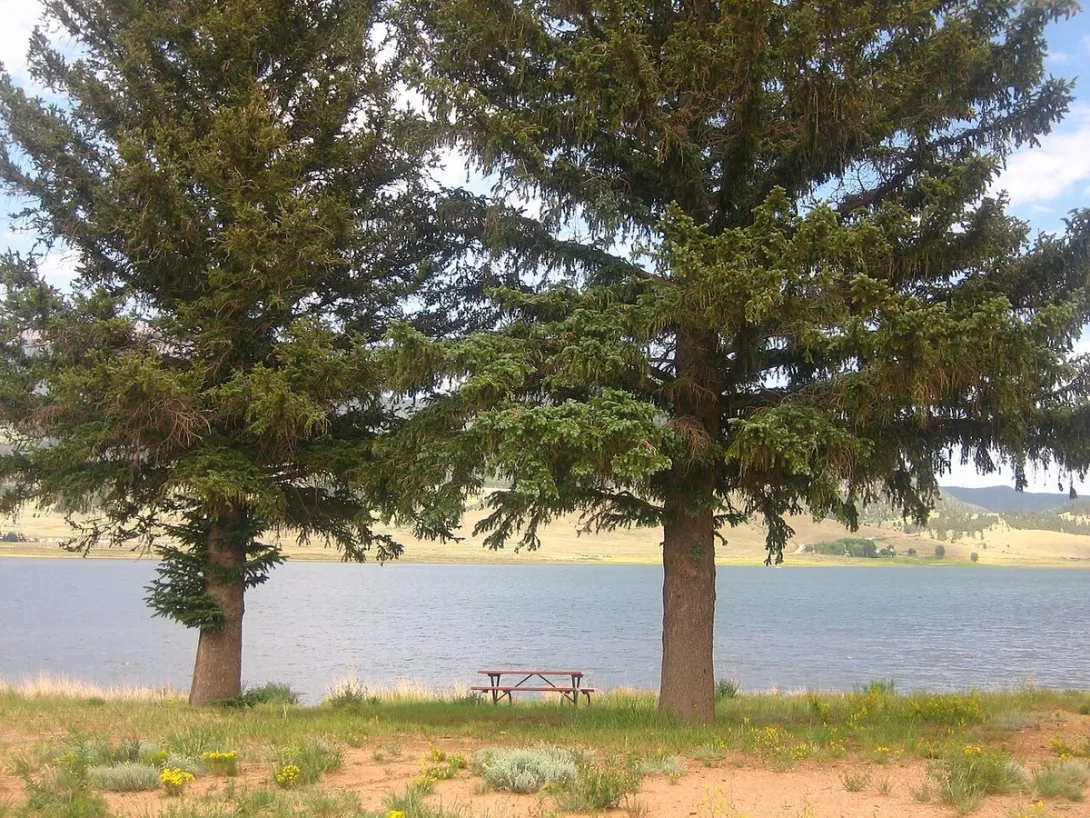
When work began on Eagle Nest Dam in 1916, the water behind it had one main job: irrigation. Rancher and entrepreneur Charles Springer, working with engineer Neal Solvangen, built the dam on the Cimarron River to capture surplus flows that otherwise rushed past the Moreno Valley in spring. To help finance the project, Springer sold water rights from the new reservoir to local farmers, and those original deeded rights became known as the vested rights. The lake that filled behind the dam, at about 8,300 feet in elevation, can hold almost 70,000 acre-feet of water.
Click to see more photos of Eagle Nest Lake
The valley around the lake did not stand still, and neither did its water. Over the years, Eagle Nest water rights were gradually transferred from farming and ranching to meet the needs of growing populations as far away as the cities of Raton and Springer. The villages of Angel Fire and Eagle Nest, which had sprung up around the lake, bought rights to Eagle Nest water as well. Alongside the old vested rights, contract rights, known as Tier-Two rights, were sold for additional bulk water deliveries, so the same stored snowmelt began serving kitchen taps and town water systems as well as hayfields.
Raton went the furthest down that road. The city paid to acquire over 3,000 acre-feet of Eagle Nest water rights, and paid as well to store and protect any unused allocations inside the reservoir. Shortly before the state acquired the reservoir in 2002, Raton even filed a court action to confirm its right to that private storage. Court-ordered mediation failed, and for a time it looked as if the water users of the Cimarron Basin were facing years more of litigation over who could keep water in the lake, and how much.
The state's purchase of the reservoir in 2002 changed who held the keys, but not the water's daily work. The Game and Fish Commission now owns the reservoir, and the New Mexico Interstate Stream Commission operates it and administers its water rights, providing water to fulfill approximately 16,000 acre-feet of demand each year for both municipal and agricultural uses. Much of that water still travels the old way: released into the Cimarron River below the dam, then moved at diversion points into the canals and ditches of districts such as the Springer Ditch Company, the Antelope Valley Irrigation District, and the Vermejo Conservancy District, with some of it traveling 50 miles downstream before it is used.
So the lake you see from our shoreline wears two hats at once. It is a mountain lake for trout, boats, and quiet evenings, and it is also a working savings account of water, drawn on by farms, ranches, and towns across Colfax County. A century ago its water belonged almost entirely to the fields. Today it still waters those fields, but it also fills glasses in Raton, Springer, Angel Fire, and Eagle Nest, a reminder that in northern New Mexico, water history is never really finished.