
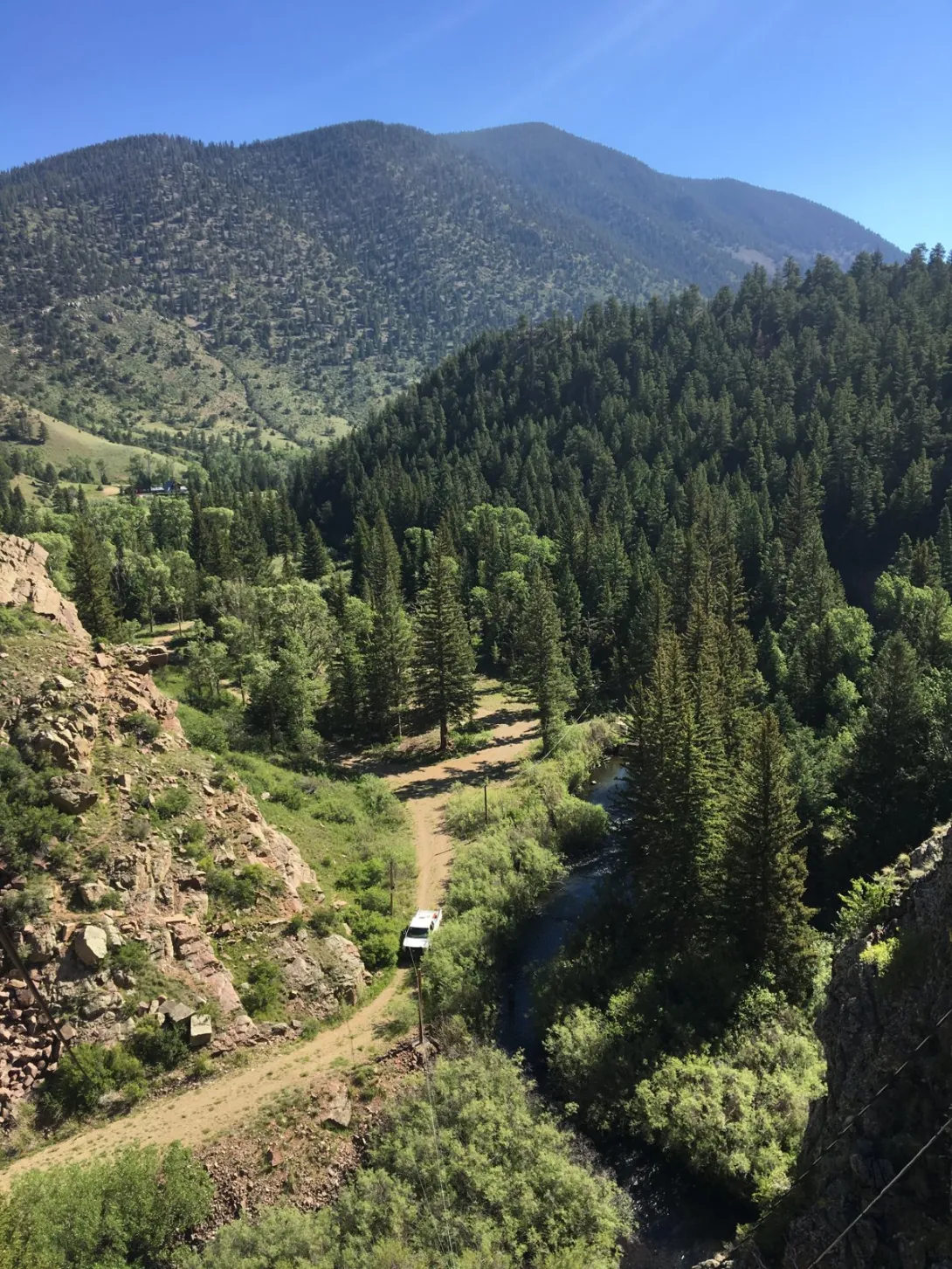
When you stand at Eagle Nest Lake State Park and look east, the water in front of you is only at the start of its working journey. The lake was built to store the surplus and flood flows of the Cimarron River, and the water it holds was never meant to stay in the Moreno Valley. Released through the gated outlet works of Eagle Nest Dam, it enters the Cimarron River in its narrow granite canyon and begins a trip that can carry it fifty miles downstream to the farms and ranches it was promised to more than a century ago.
Click to see more photos of Eagle Nest Lake
That downstream country was trying to water itself long before the big dam existed. The National Register nomination for Eagle Nest Dam records that a number of small irrigation projects were developed in the area in the 1880s and 1890s, and that individual ranchers built small dams to store the waters of streams crossing their holdings even before the turn of the century. Hundreds of small lakes from those efforts still dot the high plains from the Colorado border to Springer. Only two efforts reached a large scale in the nineteenth century, the Maxwell Project and the Springer Ditch System.
The big reservoir nearly grew out of those smaller works. In 1911 a group of ranchers, including men from the Springer Ditch Company and the French Tract Corporation, joined Charles Springer in building a series of small dams and canals, but the proposed large project was postponed. Five years later Springer announced that the large dam would begin, and when construction was completed in late 1920, the nomination notes, ranchers and farmers in northeastern New Mexico could depend on a reliable and consistent supply of irrigation water. The dam was designed to store water for the irrigation of more than 40,000 acres in eastern Colfax County.
Today the river itself does most of the carrying. Its headwaters are Moreno, Sixmile, and Cieneguilla creeks in the Sangre de Cristo Mountains, which feed into Eagle Nest Dam. From the dam the Cimarron runs for sixty miles to below Springer, in the Taylor Springs area, where it flows into the Canadian River. Along the way it is used primarily to convey runoff water from the Moreno Valley to local farmers and ranchers downstream who hold water rights from Eagle Nest Lake. At several diversion points the river gives up its water into canals and ditches, and the three major irrigation districts are the Springer Ditch Company, the Antelope Valley Irrigation District, and the Vermejo Conservancy District.
Because every delivery begins at the dam, the outflow is still carefully measured. The United States Geological Survey makes streamflow measurements on the Cimarron River below the dam to measure that outflow, a quiet reminder that the lake is a working reservoir as well as a place to fish and boat. For visitors, Eagle Nest Lake is mountain water under Wheeler Peak and Baldy Mountain. For the fields far below in eastern Colfax County, it is the start of a fifty-mile delivery that began with small nineteenth-century ditches and became the largest private irrigation project in New Mexico.