
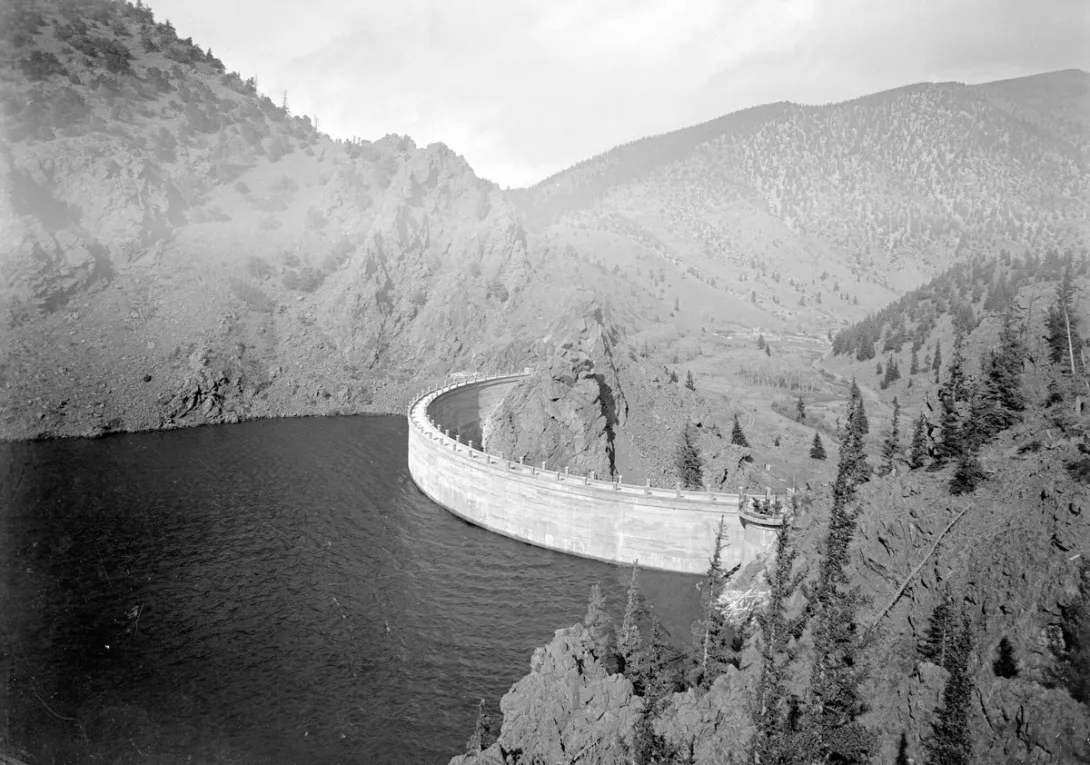
From the shoreline at Eagle Nest Lake State Park, the water looks calm and natural, as if the Moreno Valley had always held a lake. The reason it stays here sits hidden in a narrow canyon just east of the village, where Eagle Nest Dam curves across the Cimarron River. The crest of the dam is only 9.5 feet thick, yet it holds back a reservoir of 79,120 acre-feet. Its strength does not come from thickness. It comes from its curve, which pushes the weight of the lake into the granite canyon walls on either side.
Click to see more photos of Eagle Nest Dam
The dam began as an irrigation idea. Charles Springer purchased a six hundred acre dam site from the Maxwell Land Grant Company in 1906, and in 1907 Frank and Charles Springer and the Cimarron Valley Land Company received Permit No. 71 to store the surplus and flood waters of the Cimarron River. The stored water was meant to irrigate more than 40,000 acres of farmland in eastern Colfax County. Almost ten years passed before the Springers hired the San Antonio engineering firm of Bartlett and Ranney to design and build the dam, with Willis Ranney serving as chief engineer and Neal Hanson as construction superintendent.
The National Register nomination describes the finished structure as a masonry dam of cyclopean concrete, arched in type and curved on its upstream face to a radius of 155 feet, with 26,000 cubic yards of masonry in the structure itself. The dam stands 140 feet high and follows an arc 400 feet long, widening from 9.5 feet at the crest to 45.2 feet at the base, and it contains no reinforcing steel. Before construction, the canyon it spans measured only 40 feet wide at the base and 350 feet at the top, and its walls are formed of red granite and porphyry. The spillway alone required the excavation of 16,000 cubic yards of granite on the left side of the reservoir.
Building in that tight canyon demanded ingenuity. Most of the labor was provided by workers from Taos Pueblo, and a temporary town near the site housed several hundred laborers recruited from across the state, while equipment and supplies arrived through Cimarron. Because the river was carried over the work site in a flume suspended by cables, blasting could be done only in small charges. A trestle ran from the concrete batching plant below the site to a 65-foot boom that lifted concrete in buckets to the forms. Major construction began in early 1918, the structure rose above water level in 1919, and severe winter freezes in 1919 and 1920 made it impossible to lay cement during much of the year.
When the work was finished, the result was considered the largest privately built dam in the United States, and the lake behind it covered about 2,500 acres, stretching 5 miles long and 2 miles wide with a surface elevation of 8,172 feet when full. More than a century later, that slender arch is still doing the job it was designed for, storing Cimarron River water in the high valley and releasing it downstream for farms and ranches. When you stand on our shore and look across the lake toward the canyon, you are looking at the quiet half of the story. The other half is the curve of concrete leaning on granite, holding it all in place.