Skip to header Skip to main navigation Skip to main content Skip to footer

Search form

Home
Eagle Nest New Mexico
Where the Mountains Meet the Lake

Main navigation

  • Home
  • Dining
  • Lodging
  • Shopping
  • Things to Do
  • Outdoors
  • History
  • Webcams
  • Business Directory

Moreno Valley

The Perch That Filled the Lake: The Boom and Quiet Fade of Eagle Nest's Yellow Perch
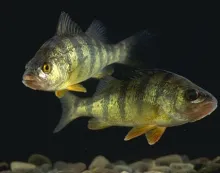
Two yellow perch with dark vertical stripes and golden fins swimming over gravel

Not every fish in Eagle Nest Lake was put here on purpose. Yellow perch, known to scientists as Perca flavescens, were illegally introduced sometime in the 1990s, before the State Wildlife Commission purchased the lake in 2002 to provide angling opportunities for the public. Nobody stocked them, nobody planned for them, and yet within a few years these striped, golden fish had become a familiar part of a day on this high mountain water, which covers more than 2,200 acres when full.
  • Read more about The Perch That Filled the Lake: The Boom and Quiet Fade of Eagle Nest's Yellow Perch

The Hands That Raised the Arch: Taos Pueblo Laborers Built Eagle Nest Dam

View from Eagle Nest Dam overlooking the Cimarron River in its canyon below the dam, photographed in July 2017.

Did you know that the great concrete arch at the head of Cimarron Canyon was raised, bucket by bucket, largely by laborers from Taos Pueblo? The dam that created Eagle Nest Lake carries the names of Frank and Charles Springer, the ranchers who won Permit No. 71 in 1907 and financed the project through the Cimarron Valley Land Company. The work itself, however, belonged to the crews who lived beside the canyon and built the structure with their hands. Local history records that most of the labor for building the dam was provided by the Taos Pueblo people.

  • Read more about The Hands That Raised the Arch: Taos Pueblo Laborers Built Eagle Nest Dam

The Book That Saved the Valley's Stories: Lure, Lore, and Legends

A pasture in the Moreno Valley near Eagle Nest, New Mexico, looking toward Wheeler Peak.

Did you know that, for more than a century, some of the best Moreno Valley history was never written down at all? It lived in kitchen-table stories told by ranching and mining families around Eagle Nest and Angel Fire. Until the 1990s, little had been written about the history of northern New Mexico's Moreno Valley, and local business people saw the risk plainly: when the old-timers were gone, their memories would go with them.

  • Read more about The Book That Saved the Valley's Stories: Lure, Lore, and Legends

Pronghorn in the Moreno Valley: Built for Speed on Open Grassland

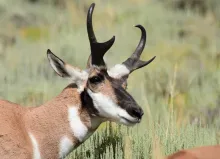
A pronghorn buck with pronged horns and a black cheek patch stands in sagebrush grassland.

On a clear late fall morning, the open grassland of the Moreno Valley can seem empty at first glance. Look again, slowly, and the tan and white shapes resolve into pronghorn, grazing and watching the road from a careful distance. Drivers approaching Eagle Nest have long met these herds on the high grasslands at the valley edge, and November is a fine time to appreciate an animal made for wide country, cold wind, and long views.

  • Read more about Pronghorn in the Moreno Valley: Built for Speed on Open Grassland

Fifty Miles Downstream: How Eagle Nest Water Reaches the Fields

View from Eagle Nest Dam overlooking the Cimarron River below the dam, where outflow from the lake is measured.

When you stand at Eagle Nest Lake State Park and look east, the water in front of you is only at the start of its working journey. The lake was built to store the surplus and flood flows of the Cimarron River, and the water it holds was never meant to stay in the Moreno Valley. Released through the gated outlet works of Eagle Nest Dam, it enters the Cimarron River in its narrow granite canyon and begins a trip that can carry it fifty miles downstream to the farms and ranches it was promised to more than a century ago.

  • Read more about Fifty Miles Downstream: How Eagle Nest Water Reaches the Fields

The Polite Dancers of Elizabethtown: Black Jack Ketchum's Gang in the Valley

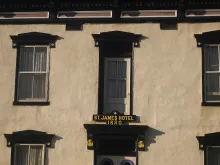
The St. James Hotel in Cimarron, the former Lambert's Inn frequented by the Ketchum gang in the 1890s.

Did you know that some of the most welcome guests at dances in Elizabethtown and Cimarron in the 1890s were train robbers? Thomas Edward Ketchum, born on October 31, 1863, in San Saba County, Texas, and his older brother Sam had worked as cowboys on ranches throughout West Texas and northern and eastern New Mexico. In New Mexico, their gang was well known at dances, social functions, and saloons across the northeast. The young men rode good horses, flashed plenty of money, and claimed to be cowboys, and local women were enraptured by their manners.

  • Read more about The Polite Dancers of Elizabethtown: Black Jack Ketchum's Gang in the Valley

Doors Carried One by One: How the Eagle Nest Lodge Became the Lake's First Luxury Resort

Eagle Nest Lake below Baldy Mountain in the Moreno Valley, the view overlooked by the Eagle Nest Lodge built in 1927.

Did you know that the grandest doors at Eagle Nest once arrived one at a time in the back of a touring car? In 1927, Oklahoma oilman Walter Gant hired William B. “Bill” Tyer of Ardmore, Oklahoma, to build and run a resort on the prime lakefront land Gant owned overlooking Eagle Nest Lake. Tyer lived in a cabin on the property, hired construction crews, and oversaw every detail of what would become Eagle Nest's first luxury resort. Gant's father made the lodge's magnificent old doors by hand in Oklahoma City and carried them to New Mexico in a Cord touring car, one door at a time.

  • Read more about Doors Carried One by One: How the Eagle Nest Lodge Became the Lake's First Luxury Resort

Greenie Peak by Forest Road 54: A Late-Season Climb Above the Moreno Valley

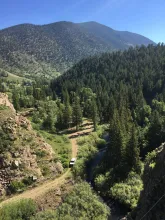
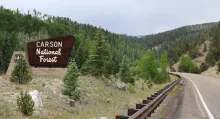
The Carson National Forest entrance sign beside New Mexico State Road 38 between Red River and Bobcat Pass, with forested slopes behind it.

From Eagle Nest, some of the best high-country driving in the Enchanted Circle begins with a paved climb. New Mexico State Road 38 rises east out of the Moreno Valley, crosses Bobcat Pass at 9,836 feet, and drops into Red River, and just beyond that corridor stands Greenie Peak, a summit of more than 11,200 feet in the Carson National Forest. The motorized way up is the Forest Road 54 system, a designated route that climbs toward the peak through pine and aspen forest, and in mid-November it offers Eagle Nest drivers one last look at the high country before winter takes hold.

  • Read more about Greenie Peak by Forest Road 54: A Late-Season Climb Above the Moreno Valley

Thirty Years Before the Water Rose: The Long Wait for Eagle Nest Lake

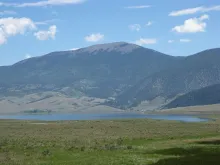
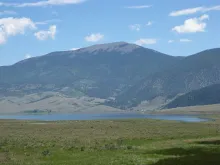
Eagle Nest Lake seen across the grassland of the Moreno Valley floor, with a forested mountain rising behind the water.

When you stand on the shore at Eagle Nest Lake State Park, the water looks as if it has always belonged here. The lake spreads about five miles long and two miles wide across the Moreno Valley floor, its surface sitting at 8,172 feet when full, beneath Wheeler Peak and Baldy Mountain. Yet this lake was imagined for thirty years before the water rose, and the valley floor it covers was working farmland whose owners did not give it up easily.

  • Read more about Thirty Years Before the Water Rose: The Long Wait for Eagle Nest Lake

A Thousand Acres in One Afternoon: How the CS Ranch Began in 1873

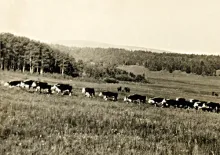
A historic black-and-white photograph of CS Ranch cattle grazing in a grassy pasture below forested hills near Cimarron.

Did you know that one of northern New Mexico's most enduring cattle ranches began with a single afternoon's decision? In February 1873, Frank Springer, a young man from Iowa who had come west the year before as a lawyer for the Maxwell Land Grant, rode north from Las Vegas to Cimarron on company business.

  • Read more about A Thousand Acres in One Afternoon: How the CS Ranch Began in 1873

Pagination

  • Page 1
  • Next page ››
Subscribe to Moreno Valley

Eagle Nest, NM Weather

Loading current conditions...

Loading forecast...

Upcoming Events

🎉 Eagle Nest Events Calendar

Annual Favorites:
Fourth of July Parade, Barbecue, and Fireworks over the Lake
High Country Arts Festival — Late July, Enchanted Eagle Park
BalloonFest over Eagle Nest Lake
Fish Fest and Pike Round-Up — September, Eagle Nest Lake State Park

Article Archive

Browse past articles