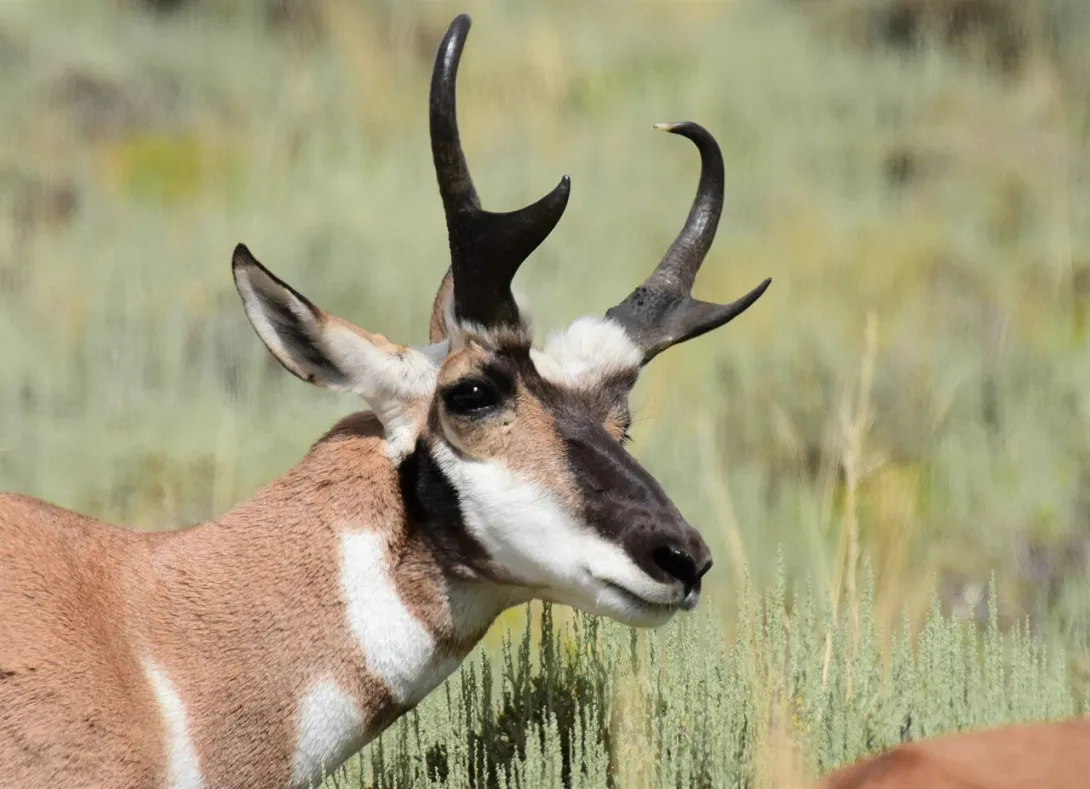
On a clear late fall morning, the open grassland of the Moreno Valley can seem empty at first glance. Look again, slowly, and the tan and white shapes resolve into pronghorn, grazing and watching the road from a careful distance. Drivers approaching Eagle Nest have long met these herds on the high grasslands at the valley edge, and November is a fine time to appreciate an animal made for wide country, cold wind, and long views.
Click to see more photos of pronghorn
The pronghorn is found in North America and nowhere else in the world, and the National Park Service traces its lineage back some 20 million years on this continent. It is the fastest land mammal in North America, able to sprint at 45 to 50 miles per hour, a speed biologists link to outrunning predators that no longer exist. Its large eyes give it exceptional vision across open ground, and when one animal senses danger, it flares the bright white patch on its rump so the rest of the herd gets the warning at once.
No other horned animal is quite like it. Both bucks and does can carry horns, though the does have only small spikes. A buck carries pronged horns that can reach well over a foot long, with a black cheek patch below the eye, and the outer sheath of each horn is shed and grown again every year over a permanent bony core. In the Moreno Valley the herds feed on the grasses, forbs, and shrubs of the open valley floor, and their numbers rise and fall with rain and the quality of the forage, a link researchers with the U.S. Geological Survey are documenting across the Southwest.
As winter approaches at more than 8,000 feet, pronghorn gather in larger groups and shift toward ground where the snow stays shallower and food remains within reach above it. Open, connected grassland matters to them, because fences and other barriers can block the seasonal movements they depend on, and wildlife agencies across New Mexico work with landowners on fence changes that let pronghorn pass. Much of the valley floor is private ranch land, so the best watching is from public roads and pullouts around Eagle Nest, with binoculars doing the close work while the animals stay undisturbed.
Know before you go
Watch pronghorn ethically and give them plenty of room. The National Park Service asks viewers to stay at least 25 yards from pronghorn and other wildlife, and to give them more space if they stop feeding, stare, or move away. Never feed wildlife, stay on roads and trails, respect private ranch land and fences, and use binoculars, a spotting scope, or a long lens for a closer view. Sensitive exact locations are intentionally not shared, so please enjoy these herds from a respectful distance and let them stay wild.