
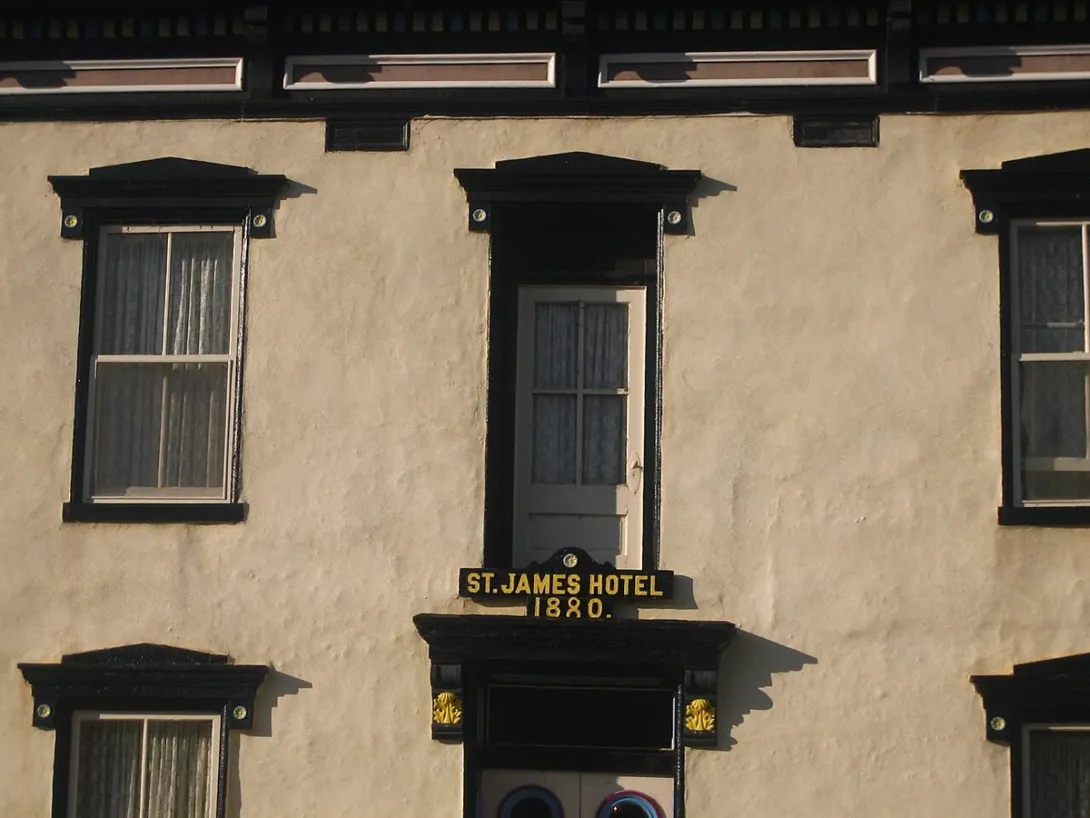
Did you know that some of the most welcome guests at dances in Elizabethtown and Cimarron in the 1890s were train robbers? Thomas Edward Ketchum, born on October 31, 1863, in San Saba County, Texas, and his older brother Sam had worked as cowboys on ranches throughout West Texas and northern and eastern New Mexico. In New Mexico, their gang was well known at dances, social functions, and saloons across the northeast. The young men rode good horses, flashed plenty of money, and claimed to be cowboys, and local women were enraptured by their manners. They frequented several establishments in Elizabethtown and Cimarron, specifically Lambert's Inn, now the St. James Hotel in Cimarron. Only later, when they were captured, did townspeople learn that their polite guests were members of Black Jack Ketchum's outlaw gang.
Click to see more photos of Black Jack Ketchum
The name itself was a case of mistaken identity. Ketchum was reportedly tagged Black Jack after being mistaken for another outlaw, Black Jack Christian, and the name stuck. By then the brothers were already robbing trains. In 1892, Tom, Sam, and several others stopped a train outside Nutt, New Mexico, and made off with about 20,000 dollars, a payroll that was never found. On September 3, 1897, the gang robbed another train and escaped with about 20,000 dollars in gold and 40,000 dollars in silver, hiding afterward in a cave south of Folsom.
The end began in the summer of 1899, in country Moreno Valley readers know well. On July 11, 1899, Sam Ketchum, Bill Carver, and Elza Lay, also known as William McGinnis, robbed a train near Folsom without Tom. A posse pursued them to a hideout in Turkey Creek Canyon near Cimarron, a place still remembered as Black Jack's Hideout. In the battle on July 16, Sheriff Edward Farr was killed, Sam and McGinnis were wounded and captured, and Carver escaped. Sam died of his wound on July 24, 1899, in the Santa Fe penitentiary.
Unaware of his brother's fate, Tom tried one last robbery alone on August 16, 1899, boarding the same train near Folsom after dark. Conductor Frank Harrington, whose train was being held up for the third time, met him with a shotgun and hit him in the right elbow, nearly severing the arm. Ketchum was captured the next morning, taken to Trinidad, Colorado, where his arm was amputated, and then transferred to Clayton, New Mexico, for trial. He was convicted and sentenced to death by hanging for felonious assault upon a railway train.
Clayton had never hanged a man, and the execution on April 26, 1901, became a grim spectacle. Stores closed, tickets were sold, and at 1:13 in the afternoon Ketchum was dropped through the trap. Because the rope had been tested the night before with a 200-pound sandbag and had become rigid, he was decapitated by the fall. He was the only person ever hanged in Union County, and the only person in New Mexico to suffer capital punishment for that train-assault offense, a law later found unconstitutional. The polite dancers of Elizabethtown had become a legend the valley still tells, half warning and half wonder.