Skip to header Skip to main navigation Skip to main content Skip to footer

Search form

Home
Eagle Nest New Mexico
Where the Mountains Meet the Lake

Main navigation

  • Home
  • Dining
  • Lodging
  • Shopping
  • Things to Do
  • Outdoors
  • History
  • Webcams
  • Business Directory

New Mexico History

Thin at the Top, Strong in the Curve: How Eagle Nest Dam Holds the Lake
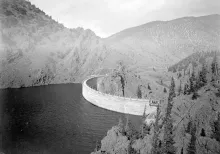
Historic black-and-white photograph of the curved concrete arch of Eagle Nest Dam holding back Eagle Nest Lake between granite canyon walls.

From the shoreline at Eagle Nest Lake State Park, the water looks calm and natural, as if the Moreno Valley had always held a lake. The reason it stays here sits hidden in a narrow canyon just east of the village, where Eagle Nest Dam curves across the Cimarron River. The crest of the dam is only 9.5 feet thick, yet it holds back a reservoir of 79,120 acre-feet. Its strength does not come from thickness. It comes from its curve, which pushes the weight of the lake into the granite canyon walls on either side.
  • Read more about Thin at the Top, Strong in the Curve: How Eagle Nest Dam Holds the Lake

Stone, Granite and Cyclopean Concrete: How Eagle Nest Dam Leans on Its Canyon

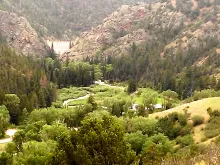
The Cimarron River valley below Eagle Nest Dam, with the dam face visible between the granite canyon walls in the distance.

Did you know that Eagle Nest Dam holds back Eagle Nest Lake not by brute weight alone, but by leaning into the canyon itself? East of the village, where the Cimarron River leaves the Moreno Valley, the river squeezes through a narrow gorge of red granite and porphyry. Before construction began, the National Register nomination recorded, that canyon measured only 40 feet wide at its base and 350 feet at the top. It was exactly the kind of tight, hard-rock slot an arch dam is made for, and the builders used every inch of it.

  • Read more about Stone, Granite and Cyclopean Concrete: How Eagle Nest Dam Leans on Its Canyon

A Cemetery Below the Chapel: How a Father's Wish Became Living History

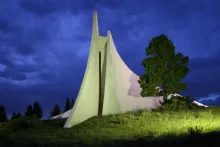
The Peace and Brotherhood Chapel at the Vietnam Veterans Memorial in Angel Fire, illuminated at dusk on its hill above the Moreno Valley.

Did you know that the white chapel on the hill above Angel Fire was only the beginning of its founder's dream? Victor “Doc” Westphall and his wife Jeanne built the Vietnam Veterans Peace and Brotherhood Chapel after their son, Marine First Lieutenant Victor David Westphall III, was killed near Con Thien on May 22, 1968, and the chapel was dedicated on May 22, 1971, as the first major memorial created to honor the veterans of the Vietnam War.

  • Read more about A Cemetery Below the Chapel: How a Father's Wish Became Living History

Still Working After a Century: Eagle Nest Dam as Living History

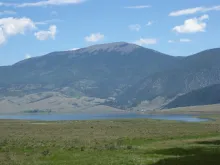
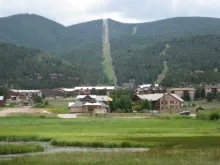
Eagle Nest Lake seen across the grassy Moreno Valley floor, its blue water backed by forested mountain slopes under a summer sky.

Some landmarks you visit behind a rope. Eagle Nest Dam is not one of them. More than a century after Taos Pueblo laborers raised its concrete arch in Cimarron Canyon, the dam is still on duty every day, holding back the Cimarron River to form Eagle Nest Lake and releasing water for the farms and ranches it was built to serve. Frank and Charles Springer and the Cimarron Valley Land Company received Permit No. 71 in 1907, and construction ran from 1916 to 1918.

  • Read more about Still Working After a Century: Eagle Nest Dam as Living History

The Peaceable Man Who Turned Hard: Wall Henderson of Elizabethtown

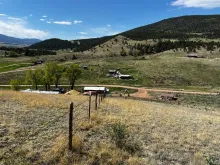
View over the former Elizabethtown townsite from its cemetery, looking across the Moreno Valley toward forested hills.

Did you know that one of Elizabethtown's earliest hard cases began, by every account, as a peaceable man? The gold camp that stood five miles north of today's Eagle Nest, on what is now New Mexico State Road 38, drew thousands of miners after gold was found in the Moreno Valley in 1866. The History of New Mexico, published in 1907, opens its account of those first years plainly: in the early days of the gold camp at Elizabethtown, crime was rampant, desperate characters flocked in from all quarters after the discovery of gold on the Maxwell ranch, and human life was held very cheap.

  • Read more about The Peaceable Man Who Turned Hard: Wall Henderson of Elizabethtown

The Railroad That Never Reached Eagle Nest: A Tunnel Above the Dam

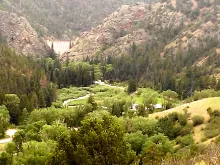
The Cimarron River winds through its forested canyon below Eagle Nest Dam, whose pale concrete face shows between the granite walls in the distance.

Did you know that no train has ever rolled into Eagle Nest? The Moreno Valley came tantalizingly close to a railroad in the first years of the 1900s, and the effort left a permanent mark on Cimarron Canyon: a tunnel cut through solid rock above the site of Eagle Nest Dam, bored for trains that never came. The story begins not in the valley, but in the coal country around Raton.

  • Read more about The Railroad That Never Reached Eagle Nest: A Tunnel Above the Dam

The Stone Mill That Fed an Empire: Maxwell's Aztec Mill at Cimarron

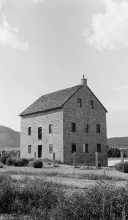
Black-and-white photograph from 1936 of the stone Aztec Mill in Cimarron, New Mexico, seen from the southeast.

Drive east from Eagle Nest through Cimarron Canyon, and at the far end of the canyon you reach Cimarron, the old headquarters of the Maxwell Land Grant. One stone building there still tells the story of how that empire fed itself. It is the Aztec Mill, built in 1864 by Lucien B. Maxwell, and the National Park Service once described it as a noted Santa Fe Trail landmark that looks today precisely as it did a century ago.

  • Read more about The Stone Mill That Fed an Empire: Maxwell's Aztec Mill at Cimarron

From Cattle Ranch to Angel Fire: How the LeBus Ranches Changed the South Valley

A grassy meadow and pond at Angel Fire, New Mexico, with resort buildings and forested ski slopes rising behind them.

When you stand at the south end of Eagle Nest Lake and look down the Moreno Valley, you are looking across ranch country. The creeks that wander through those pastures, including Cieneguilla Creek, are among the headwaters of the Cimarron River, and they feed the lake that the dam holds back at the valley's north end. Long after the dam was built, that southern valley floor was still working land, and one family from Texas would change it more than any other in the twentieth century.

  • Read more about From Cattle Ranch to Angel Fire: How the LeBus Ranches Changed the South Valley

A Herd That Netted 700 Dollars: How a Cattle Loss Built Idlewild

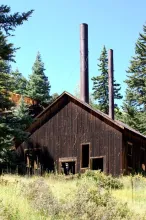
The Klondyke Mine mill near Eagle Nest in 2008, the mine beside which the Idlewild community developed in the 1930s.

Did you know that one of the Moreno Valley's most enduring little communities began with a cattle sale that went wrong? In 1929, Charles Gallagher shipped a herd of cattle to Kansas City as the stock market began to fall. He expected to receive 1,500 dollars for the herd, but he netted only 700 dollars, and market conditions forced him to sell some of his land. In this high valley between Eagle Nest and Angel Fire, that hard ranching arithmetic set a new community in motion.

  • Read more about A Herd That Netted 700 Dollars: How a Cattle Loss Built Idlewild

First in New Mexico: The Gold Town That Became a County Seat

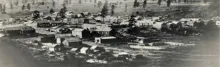
A black-and-white panoramic photograph of Elizabethtown, New Mexico in 1868, showing the new gold-rush town's buildings spread across the Moreno Valley.

Did you know the Moreno Valley gold rush began with copper, not gold? Early in 1866, Ute or Jicarilla Apache traders brought copper-bearing ore to the soldiers at Fort Union, east of the mountains. A soldier was shown where the ore had been found, high on Baldy Mountain, and staked a claim there. Known as the Mystic Lode, or simply the Copper Mine, it was the first mine in what became the Baldy Mining District, and it stood at more than 10,000 feet on a peak that rises to 12,441 feet above the valley.

  • Read more about First in New Mexico: The Gold Town That Became a County Seat

Pagination

  • Previous page ‹‹
  • Page 2
  • Next page ››
Subscribe to New Mexico History

Eagle Nest, NM Weather

Loading current conditions...

Loading forecast...

Upcoming Events

🎉 Eagle Nest Events Calendar

Annual Favorites:
Fourth of July Parade, Barbecue, and Fireworks over the Lake
High Country Arts Festival — Late July, Enchanted Eagle Park
BalloonFest over Eagle Nest Lake
Fish Fest and Pike Round-Up — September, Eagle Nest Lake State Park

Article Archive

Browse past articles