Did you know the Moreno Valley gold rush began with copper, not gold? Early in 1866, Ute or Jicarilla Apache traders brought copper-bearing ore to the soldiers at Fort Union, east of the mountains. A soldier was shown where the ore had been found, high on Baldy Mountain, and staked a claim there. Known as the Mystic Lode, or simply the Copper Mine, it was the first mine in what became the Baldy Mining District, and it stood at more than 10,000 feet on a peak that rises to 12,441 feet above the valley.
Click to see more photos of Elizabethtown — its ruins, its cemetery, and Baldy Mountain above the town site
That October, three Fort Union soldiers, Larry Bronson, Pete Kinsinger, and a soldier called Kelley, were sent up to work the copper claim. While Bronson and Kinsinger cooked a meal, Kelley tried his hand at panning, and found gold in the gravel of Willow Creek. The three men spent a few days searching the slopes, then left before winter, planning to keep the discovery secret and return in the spring. The secret spread within weeks instead, and by the spring of 1867 prospectors were flooding onto Baldy Mountain. By July of that year, 17 companies had established some 400 claims within an eight-mile radius of the peak, and the placer diggings along the Baldy streams would eventually yield about 2,250,000 dollars in gold.
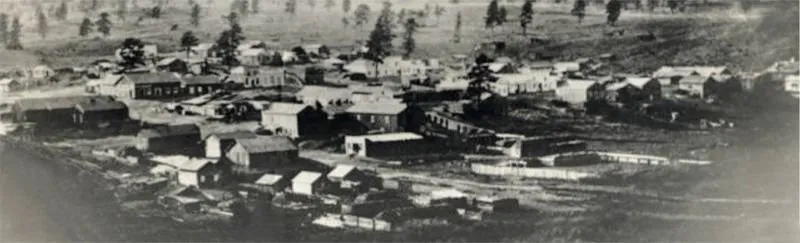
A town rose to serve them almost at once. Captain William H. Moore, the Fort Union commander who had helped open the country, founded the settlement with other businessmen and named it for his young daughter, Elizabeth Catherine Moore. Moore and his brother John opened a general store in June 1867, tents and cabins gathered around it, and the townsite was soon platted and its lots sold. By 1869 Elizabethtown counted about 100 buildings, and that year it gained its first newspaper, the Elizabeth Lantern, a sure sign that a rough mining camp was turning into a real town.
Then came the firsts that still set Elizabethtown apart. When the territorial legislature created Colfax County on January 25, 1869, naming it for Vice President Schuyler Colfax, Elizabethtown was made the county seat. A year later, in 1870, it became the first incorporated town in New Mexico. At its height that same year it boasted about 7,000 residents, with seven saloons, three dance halls, five stores, a school, and two churches, and some accounts place it among the most populous places in the territory. No other New Mexico town could claim that combination of a gold-rush boom and a county courthouse.
The glory lasted only as long as the easy gold. As the placers thinned and mining costs rose, people drifted away, and by 1872 only about 100 residents remained. That year the county seat was moved to Cimarron, on the stage road and at the headquarters of the Maxwell Land Grant. Elizabethtown revived briefly more than once, but it was mostly abandoned by 1917. Today its quiet ruins sit beside New Mexico State Road 38, about five miles north of Eagle Nest, looking out over the Moreno Valley toward Baldy Mountain, where a copper claim, a gold pan, and a soldier named Kelley started it all.