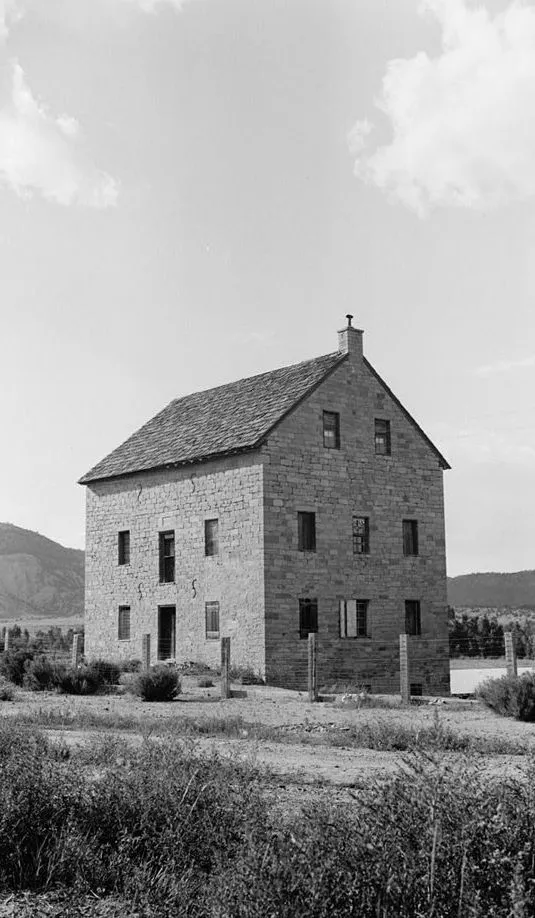
Drive east from Eagle Nest through Cimarron Canyon, and at the far end of the canyon you reach Cimarron, the old headquarters of the Maxwell Land Grant. One stone building there still tells the story of how that empire fed itself. It is the Aztec Mill, built in 1864 by Lucien B. Maxwell, and the National Park Service once described it as a noted Santa Fe Trail landmark that looks today precisely as it did a century ago.
Click to see more photos of the Aztec Mill and the Cimarron Historic District
The mill belonged to the largest private landholding in American history. The grant began in 1841, when Governor Manuel Armijo awarded the Beaubien-Miranda Grant to Carlos Beaubien and Guadalupe Miranda. Maxwell married Beaubien's daughter Luz, bought Miranda's share in 1858, and after Beaubien died in 1864 he bought out the other heirs as well. His holdings peaked at 1,714,765 acres, taking in Cimarron, Elizabethtown, and the whole Moreno Valley where Eagle Nest now stands, and he ran it all from his mansion at Cimarron.
A domain that size needed flour, and in 1864 Maxwell spent 48,000 dollars building a stone grist mill in the southwest corner of Cimarron to grind wheat and corn for local residents and soldiers. One detail made it unusual for its time: the waterwheel sat inside the building, on the ground floor, so the mill could keep working all year round, through the winter freezes that stopped outdoor wheels on other streams.
The mill soon took on a second job. In 1861 the federal Indian Agency had moved from Taos to Cimarron, and some 1,200 acres of grant land nearby were reserved for about 1,500 Ute and Jicarilla Apache people. The Aztec Mill became the staging ground where blankets, meat, flour, and grain were handed out, and the National Park Service nomination notes that Jicarilla Apaches and Utes obtained their government flour and rations there, while Santa Fe Trail travelers sometimes crowded into the mill alongside them to replenish their own flour.
Maxwell operated the mill until 1870, when he sold the grant to an English company for a reported 1,350,000 dollars and left for Fort Sumner, where he died in 1875. The Cimarron agency closed in 1876 and the Ute and Jicarilla families were moved onto reservations, and the great grant passed into the long court fights of the Colfax County War years. Through all of it, the stone mill simply stayed standing.
It stands yet. The building now houses the Old Aztec Mill Museum, open in season from about Memorial Day through Labor Day and staffed entirely by volunteers, with working mill parts inside and exhibits tracing daily life in Colfax County from the 1860s into the early twentieth century. It sits within the Cimarron Historic District, added to the National Register of Historic Places in 1973. For anyone in Eagle Nest who drives the canyon to Cimarron, it is the most solid piece of the Maxwell era left to touch: the mill that ground the flour for the valley's first empire.