Skip to header Skip to main navigation Skip to main content Skip to footer

Search form

Home
Eagle Nest New Mexico
Where the Mountains Meet the Lake

Main navigation

  • Home
  • Dining
  • Lodging
  • Shopping
  • Things to Do
  • Outdoors
  • History
  • Webcams
  • Business Directory

Eagle Nest History

Elizabeth Moore: The Little Girl a Town Was Named For
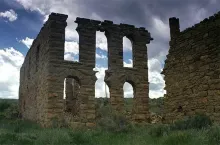
The stone ruins of the Mutz Hotel in Elizabethtown, the town named for Elizabeth Moore, via Ghost Town Gallery.

She was four years old when they named a town for her. When Elizabethtown was platted in 1868, Captain William H. Moore, who with his brother John had opened a general store below Baldy Mountain in June 1867, gave the new settlement the name of his little daughter, Elizabeth Catherine Moore. It is a charming origin for a mining town, and Elizabeth repaid it in an unexpected way: she never left.
  • Read more about Elizabeth Moore: The Little Girl a Town Was Named For

Harvesting Winter: The Ice Cutters of Eagle Nest Lake

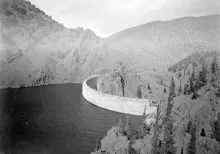
Historic Denver Public Library photograph of the Eagle Nest Dam arch and Eagle Nest Lake.

Eagle Nest Lake was built to work in the summer, storing irrigation water behind the great arch finished in 1920, when the dam was called the largest privately built dam in America. The lake stocked with fish and drew anglers all season. But for the families of the Moreno Valley, the lake's most important harvest came in the middle of winter, when the ice itself was the crop.

  • Read more about Harvesting Winter: The Ice Cutters of Eagle Nest Lake

The Aztec's Second Boom: Baldy Town's Last Bright Year

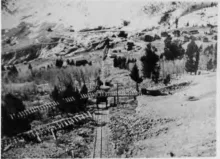
Baldy Town from the Aztec Mine, a 1925 United States Geological Survey photograph, public domain.

Mining towns are not supposed to get second acts, but Baldy Town did. The Aztec Mine, discovered in 1868 in the gulches between Ute Creek and South Ponil Creek, was the richest gold producer in the Baldy Mining District, the engine of Elizabethtown's first boom. By the 1890s, litigation and lean years had shut it down, and the town it fed was sliding toward ghosthood. The gold, everyone assumed, was gone.

  • Read more about The Aztec's Second Boom: Baldy Town's Last Bright Year

Before the Town: The Valley of Feathers and Eagles

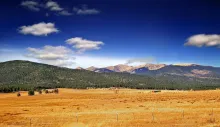
The Moreno Valley's ranch pasture looking toward Wheeler Peak, the country tribes once visited for ceremonial feathers.

Before there was a town here, there was a reason to come. A New Mexico Historic Preservation Division marker, recorded by the Historical Marker Database, tells the older story of the ground where Eagle Nest now stands: members of several tribes traveled to this high valley to collect ceremonial feathers. The Moreno Valley, long before fences or highways, was a gathering place, valued across cultures for what the eagles provided.

  • Read more about Before the Town: The Valley of Feathers and Eagles

The Little Museum That Runs the Valley's Living Room

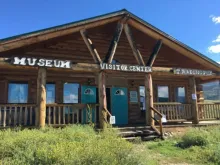
The Enchanted Circle Gateway Museum and visitor center log building in Eagle Nest, photographed for Discover Taos.

The log building at 580 East Therma Drive does more jobs than any other address in Eagle Nest. It is the Enchanted Circle Gateway Museum, the village's visitor center, and the headquarters of a volunteer-staffed community nonprofit, a project of Sangre de Cristo Communities Interacting, a 501(c)(3) organization. Travelers stop for directions; locals stop for programs; and through the door passes most of what the Moreno Valley knows about itself.

  • Read more about The Little Museum That Runs the Valley's Living Room

The Mutz Hotel: The Stone Ruin That Remembers Elizabethtown

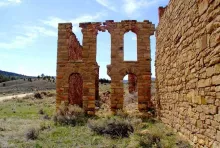
The stone ruins of the Mutz Hotel in Elizabethtown, New Mexico, photographed in 2004 by Dave Alexander.

Every ghost town has one building that carries its memory, and in Elizabethtown it is the Mutz Hotel. Or rather, what is left of it: a few low stone walls and tall window openings standing in the grass above NM 38, five miles north of Eagle Nest, photographed by nearly every traveler who stops. The ruin's story is the town's story in miniature: built on confidence, burned in a night, rebuilt in stone, and finally left to the wind.

  • Read more about The Mutz Hotel: The Stone Ruin That Remembers Elizabethtown

A Chapel Built From Grief: The Westphalls and America's First Vietnam Memorial

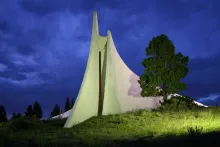
The Vietnam Veterans Peace and Brotherhood Chapel above Angel Fire at dusk, photographed by Warriors Remembered.

On a hill above the Moreno Valley, north of Angel Fire, a white chapel rises out of the grass like a sail. It is one of the most moving places in New Mexico, and it exists because a family in this valley refused to let grief be the end of the story.

  • Read more about A Chapel Built From Grief: The Westphalls and America's First Vietnam Memorial

The Vested Rights: The Water Promises Behind Eagle Nest Dam

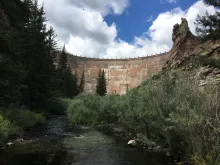
The downstream face of Eagle Nest Dam above the Cimarron River, photographed from the Village of Eagle Nest.

Eagle Nest Dam was built on a promise, and the promise was water. When Charles Springer set out to finance the dam on the Cimarron River, begun in 1916, he paid for it in part by selling water rights to the farmers of the valleys below. A farmer who bought in was buying a share of the river itself: spring runoff stored behind the arch, released through the dry months, delivered by right rather than by favor. Those sales were the financial engine of the whole project, and the buyers never forgot what they had paid for.

  • Read more about The Vested Rights: The Water Promises Behind Eagle Nest Dam

The Big Ditch: Forty Miles of Flume to Wash Gold

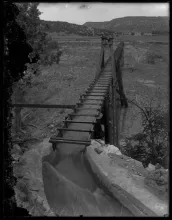
Historic photograph of the Big Ditch flume carrying water toward the Elizabethtown workings, Palace of the Governors Photo Archives.

Gold mining in the Moreno Valley had a water problem. The gravel in the gulches below Baldy Mountain was full of gold, but washing it out took water by the riverful, and the local creeks ran thin exactly when the miners needed them most. The solution, undertaken in 1868, was one of the boldest engineering gambles in New Mexico's mining era: the Big Ditch, a flume built to steal a river from the next watershed and deliver it to the diggings above Elizabethtown.

  • Read more about The Big Ditch: Forty Miles of Flume to Wash Gold

1920: The Year the Lake Arrived and a Town Began

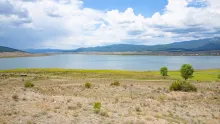
The shoreline of Eagle Nest Lake in the Moreno Valley, beside which the town was founded in 1920.

Most towns come first and acquire their landmarks later. Eagle Nest did it backwards: the landmark came first, and the town was established in 1920 to stand beside it. That was the year Eagle Nest Dam, after years of construction delayed by a world war and two killing winters, was finally completed in Cimarron Canyon. Behind the arch, the Cimarron River began spreading into a five-mile lake, and at the lake's north end a brand-new settlement took shape: Therma, the village that would become Eagle Nest.

  • Read more about 1920: The Year the Lake Arrived and a Town Began

Pagination

  • Previous page ‹‹
  • Page 4
  • Next page ››
Subscribe to Eagle Nest History

Eagle Nest, NM Weather

Loading current conditions...

Loading forecast...

Upcoming Events

🎉 Eagle Nest Events Calendar

Annual Favorites:
Fourth of July Parade, Barbecue, and Fireworks over the Lake
High Country Arts Festival — Late July, Enchanted Eagle Park
BalloonFest over Eagle Nest Lake
Fish Fest and Pike Round-Up — September, Eagle Nest Lake State Park

Article Archive

Browse past articles