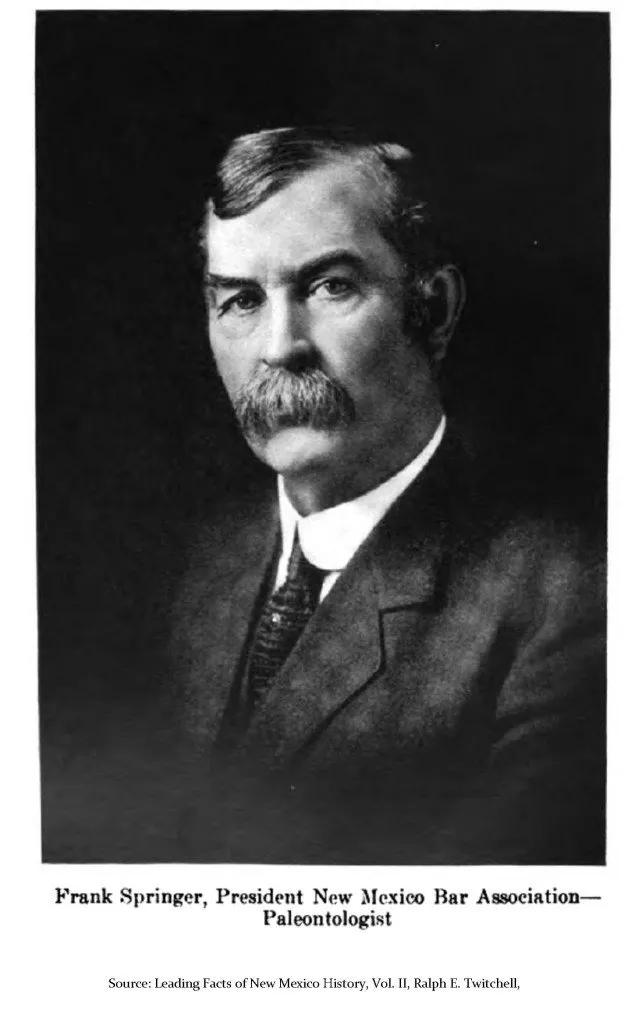
Few men left fingerprints on more of northern New Mexico's story than Frank Springer. Born in Wapello, Iowa, in 1848, he arrived in New Mexico in 1873 and settled at Cimarron, then the headquarters town of the vast Maxwell Land Grant. As the grant company's attorney, and later its president, Springer became the legal mind behind the largest privately owned estate in America, some 1.7 million acres that included the Moreno Valley and the slopes of Baldy Mountain.
His courtroom work made history. When the federal government challenged the grant's boundaries, Springer carried the case to the United States Supreme Court, which upheld the company's title to the full 1.7 million acres. It was one of the great land cases of the American West, and it fixed the ownership map that Colfax County still lives with today.
Springer was never only a lawyer. With his brother Charles, he built the C.S. Ranch, whose cattle ran on the plains east of the mountains, and the family turned its attention to another audacious idea: water. Under State Engineer Permit No. 71, the Springers' irrigation enterprise set out to dam the Cimarron River and store its spring runoff for the dry farms below. Frank's son, L. Wallace Springer, managed the enterprise that raised Eagle Nest Dam, finished in 1920, and created Eagle Nest Lake. The village of Eagle Nest exists because that water project did.
And then there were the fossils. Springer spent his life collecting crinoids, the flower-like sea animals whose fossils he gathered and studied with a scientist's patience, corresponding with leading paleontologists and publishing on his finds. In 1911 he donated his collection, one of the finest of its kind, to the Smithsonian Institution, where it remains a foundation of crinoid research.
Lawyer, rancher, dam builder, paleontologist: Springer embodied the era when a handful of determined men redrew this valley. The lake that anchors Eagle Nest today is, in no small part, his family's monument.