
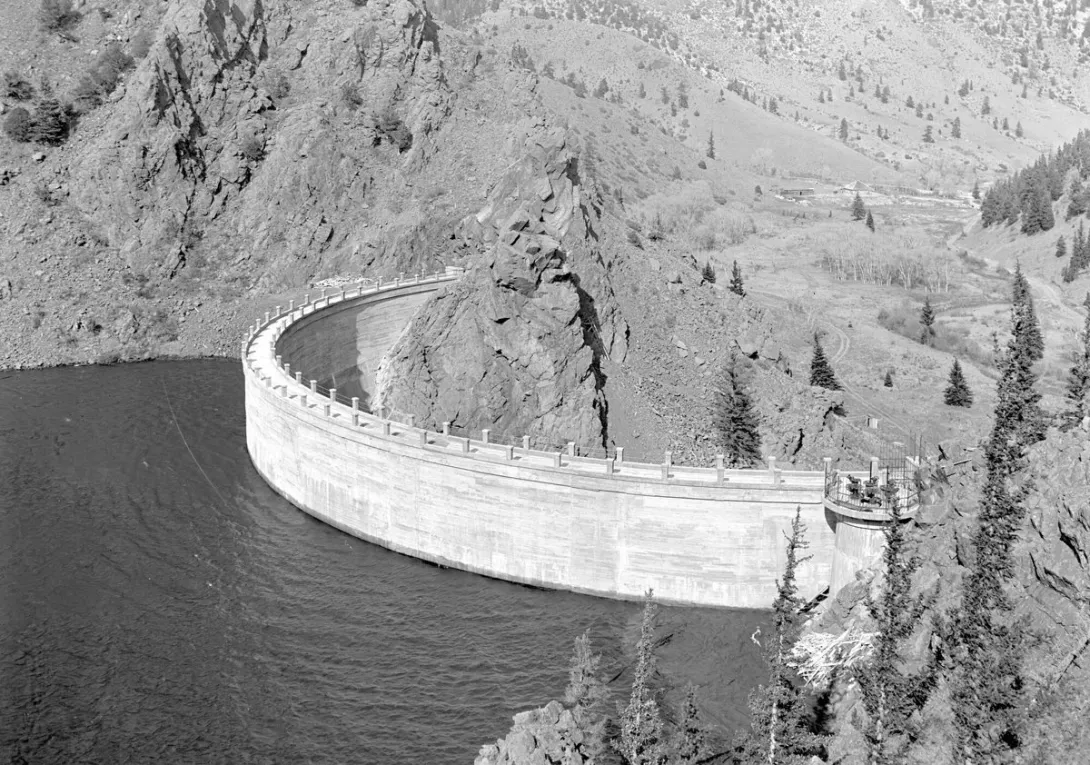
Before Eagle Nest Dam could be built, the Cimarron River had to be moved. The dam site lay in a narrow gorge where the river ran exactly where the concrete needed to go, so the builders hung a flume from cables over the worksite and sent the river sailing overhead while men worked in the dry canyon below. It was an audacious start to one of the most ambitious private engineering projects in New Mexico history.
The dam that rose in the canyon between 1918 and 1920 is a curved concrete arch, a graceful giant by the standards of its day: some 26,000 cubic yards of concrete wrapped around a radius of about 155 feet, wedged between granite walls. Even the spillway had to be carved out of the mountain, gouged from roughly 16,000 cubic yards of solid granite so floodwater could escape around the structure rather than over it.
Nothing about the schedule was kind. The First World War drained away labor and materials just as construction got underway, and the winters of 1919 and 1920 froze the canyon hard enough to stop work and crack at the young concrete's heels. Money, raised by the Springer brothers' Cimarron Valley Land and Irrigation enterprise from the sale of water rights to valley farmers, had to stretch across every delay. The dam was finally finished late in 1920, and the Cimarron began filling Eagle Nest Lake behind it.
The arch has now held the river for more than a century. It created a lake five miles long that remade the Moreno Valley's economy, first for irrigation and then for fishing, boating, and the village that grew up at its north end and took the dam's name. A century of freeze and flood has taken a toll, though: state engineers today rate the old dam's condition as poor, and the repairs it needs sit on a wish list that grows more urgent as the concrete ages.
Drive NM 38 east from Eagle Nest and the road threads the canyon beneath the arch. It is worth slowing down. Few structures in New Mexico did more to shape the country around them, and fewer still were built by first hanging a river in the air.