Did you know that one of the men who found the Moreno Valley's richest gold lode also taught New Mexico how to mine with water? Matthew Lynch arrived in the Willow Creek diggings in the spring of 1867, when hundreds of prospectors were staking claims in every gulch around Baldy Mountain. Lynch and his partner Tim Foley took claims on the south side of the gulch, across from the first locations, and they soon played a part in the early history of the gold fields that few others could match.
Click to see more photos of Elizabethtown and its gold-rush era
Lynch and Foley soon crossed to the eastern slope of Baldy Mountain and began prospecting on Ute Creek. There they first struck rich float, some of it more than half gold, and after about a year of hard work they uncovered the Aztec mine in June 1868, at the foot of Baldy on a little ridge that separates Ute Creek from South Ponil Creek. The 1907 History of New Mexico called it the richest gold lode discovery made in the West at that time. A 15-stamp mill began operating on October 29, 1868, and in its first few years the Aztec yielded as much as 21,000 dollars a week, with ore averaging 68.85 dollars a ton in an 1870 government report. Litigation shut the mine down in 1872, after it had produced about 1,500,000 dollars.
Back on the west side of Baldy, the placer miners around Elizabethtown faced a stubborn problem: the gold was in the gravel, but water to wash it was scarce, and the United States Geological Survey later noted that the scarcity made placer work expensive. Lynch's answer was hydraulic mining, using pressurized water to blast gold-bearing gravel into sluices. With only one or two minor exceptions, the early mining histories regard him as the father of hydraulic mining in New Mexico, and for a dozen years he was known as the most successful hydraulic miner in the fields, running three to four hydraulics each season.
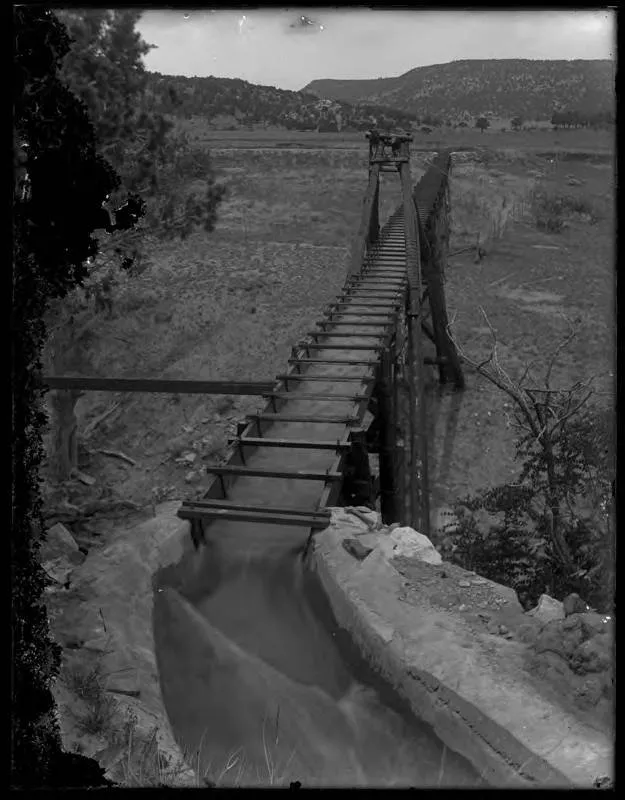
His biggest step came in 1875, when he purchased the Big Ditch from Lucien B. Maxwell and repaired the long flume system built to bring Red River water to the Baldy placers. During the five years Lynch owned and operated the ditch, its output was very large. The Lothian ground yielded 75,000 dollars in one season's run with only one hydraulic, and a single claim on Willow Creek yielded forty ounces of gold from one box of ground, a piece just twelve by twenty-four feet. Lazy Gulch produced as much as 120 ounces a week, while New Orleans Flats was known to have yielded as high as 228 ounces in one week, at 19 dollars an ounce.
Lynch remained, in the words of the 1907 history, the master spirit of the hydraulic development of the placer fields until his death in 1880, when he was killed by a falling tree. After his death the ditch passed to James and Patrick Lynch, who operated it for a number of years before it gradually fell into disuse. The town he helped enrich, Elizabethtown, faded with the mines, but the story endures: above Eagle Nest, the quiet gulches around Baldy still trace the ground where a determined Irish-born miner turned ditch water into gold and changed how New Mexico mined.