Stand in Eagle Nest on a clear morning and look northeast, and one peak owns the skyline: Baldy Mountain, 12,441 feet high, the tallest summit in the Cimarron Range, rising about six miles from town with a bare, treeless crown. In October 1866, a party sent out to do development work on a copper prospect on that mountain found something else entirely — placer gold on Willow Creek, on Baldy's west slope. The news spread fast. Placer mining began the following summer, and the rush that followed built Elizabethtown, the Moreno Valley's first boomtown, and gave this quiet valley a gold story that still shapes how rockhounds should read its gravels today.
The gold did not start in the creeks. Geologists with the U.S. Geological Survey traced the Moreno Valley placers back to numerous small gold-bearing veinlets in the porphyry bedrock on the west slope of Baldy Mountain, including quartz and pyrite fissure veins. Over immense spans of time, weather loosened gold from that hard rock, and streams carried the heavy flakes and nuggets downhill. Because gold is so dense, it settled where water slowed — concentrated on hard clay layers in the gravel, in rich lenses within the gravel beds, and in crevices in decomposed bedrock. The Moreno River and Grouse and Humbug gulches became the district's most productive placer ground, and a dredge worked the Moreno River in the early 1900s.
That geology is a field lesson for beginners. Heavy minerals collect together, so a pan of gravel teaches the same sorting nature did: bright mica flakes wash light and glittery and break apart, brassy pyrite is brittle, but real gold is soft, malleable, and stays put at the bottom of the pan. Learning to tell those three apart, and to spot pale quartz veining in local bedrock, will sharpen your eye anywhere in the southern Rockies — and you can practice that identification at home with purchased gravel and at museum exhibits without disturbing a single historic gulch.
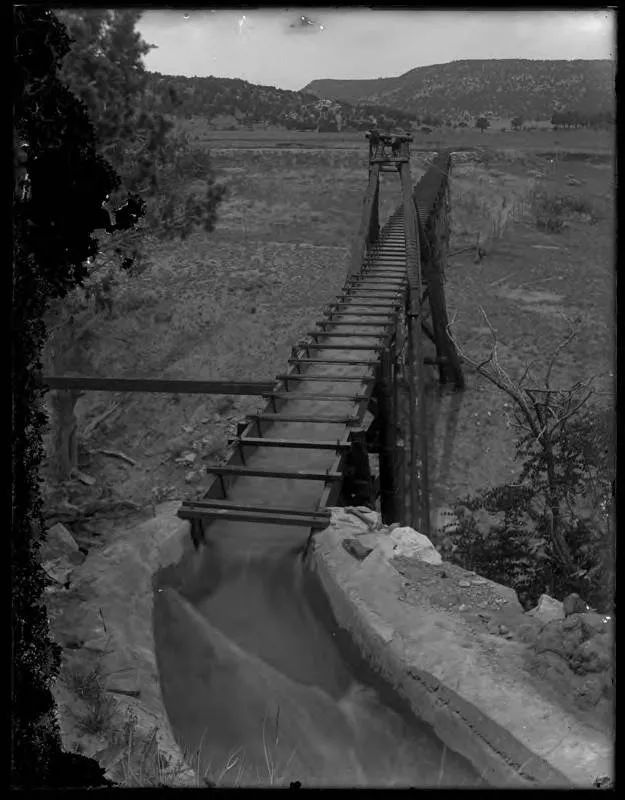
The human story followed the geology uphill. Once placer miners realized the creek gold had washed down from Baldy itself, they searched the slopes for the source, found a rich outcrop in June 1868, and opened the Aztec Mine on it, with a stamp mill running by that October. Elizabethtown boomed on the strength of both the placers and the lode mines around the mountain. Water was always scarce for washing gravel here, which is why great wooden flumes were built to carry water miles toward the Elizabethtown workings — the flume in this photograph is a reminder that Moreno Valley gold was as much an engineering struggle as a treasure hunt.
Know before you go
Collect only where it is legal, and in Baldy and Elizabethtown country the honest answer is that this is heritage ground to look at, not a place to collect. Much of the Moreno Valley floor is private ranch land, and the old mining country is laced with mining claims: patented claims are private land and need the owner's permission, and the Bureau of Land Management states that collecting on existing mining claims is prohibited without the claimholder's permission. On Bureau of Land Management public land elsewhere in New Mexico, rockhounds may collect reasonable amounts for personal use with hand tools and only minor disturbance — but always check current rules with the local land manager first, respect private land, leave historic workings alone, and pack out everything you pack in.