By 1901, Elizabethtown had already lived one full boom-and-bust life. The gold rush that made E-Town, five miles north of today’s Eagle Nest, New Mexico’s first incorporated town back in the 1860s had faded, the county seat had moved away, and the town had settled into a quieter second act. Then the machine age arrived in the Moreno Valley with an idea as bold as any prospector’s pan: instead of sending men up Baldy Mountain for gold, why not send a floating factory to dig the gold out of the creek gravel itself?
Click to see more photos of Elizabethtown and the Eleanor dredge — historic views of the boomtown, its ruins, and the dredge herself
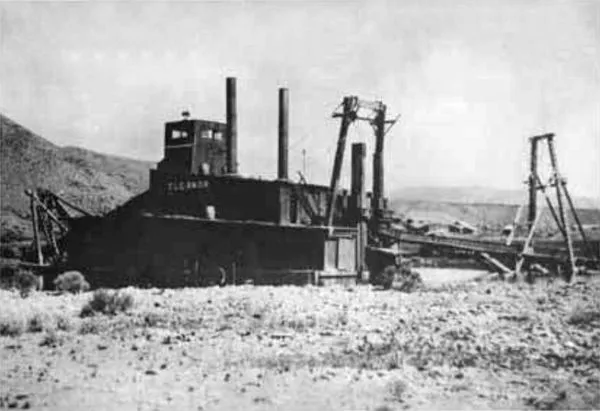
The Oro Dredging Company built that factory in 1901 and christened her Eleanor. Getting her to Elizabethtown was a feat all by itself. Piece by piece, the dredge was hauled from the railhead at Springer over mountain roads, and the company built a dam about three miles from town, with the biggest pieces hauled in on a large boat. Her machinery alone weighed some 350,000 pounds, according to a 1907 history of New Mexico — a small industrial plant, delivered to a high mountain valley.
Once assembled, Eleanor went to work on the creek below town in a way no Moreno Valley miner ever had. She floated on a pond of her own making — as she dug her way upstream, she created the very water she floated in — starting about two and a half miles below Elizabethtown and working her way toward the old camp. A line of 65 buckets chewed into the gravel, digging as deep as 22 feet below the water and cutting through far higher banks when the gravel rose above the creek. She could handle up to 4,000 cubic yards of dirt a day, working through the spring, summer and fall. The 1907 history called her the only mining dredge in operation in New Mexico, and her enterprise unique in the territory’s mining history.
Her first year repaid the faith, and then some. Eleanor paid for herself and cleared 100,000 dollars in profit, mining a remarkable one-quarter of all the gold found in New Mexico that year. For a valley that had watched fortunes come and go since 1866, it must have felt like the boom was back, this time with smokestacks.
It did not last. Her owner mortgaged Eleanor to finance a similar dredging venture in Colorado, the next year turned unprofitable, and bankruptcy followed. The dredging operation finally ended in 1905, and Eleanor was left where she floated, to rust and slowly sink into the sands of Moreno Creek. Her buried remains are still there, the histories say, though no trace of her can be seen today. Drive NM 38 past Elizabethtown now and you will see stone ruins and a quiet hillside cemetery, but the valley’s biggest gold machine lies hidden in the creek gravel she once dug, an invisible chapter of the gold rush resting below the Moreno Valley floor.