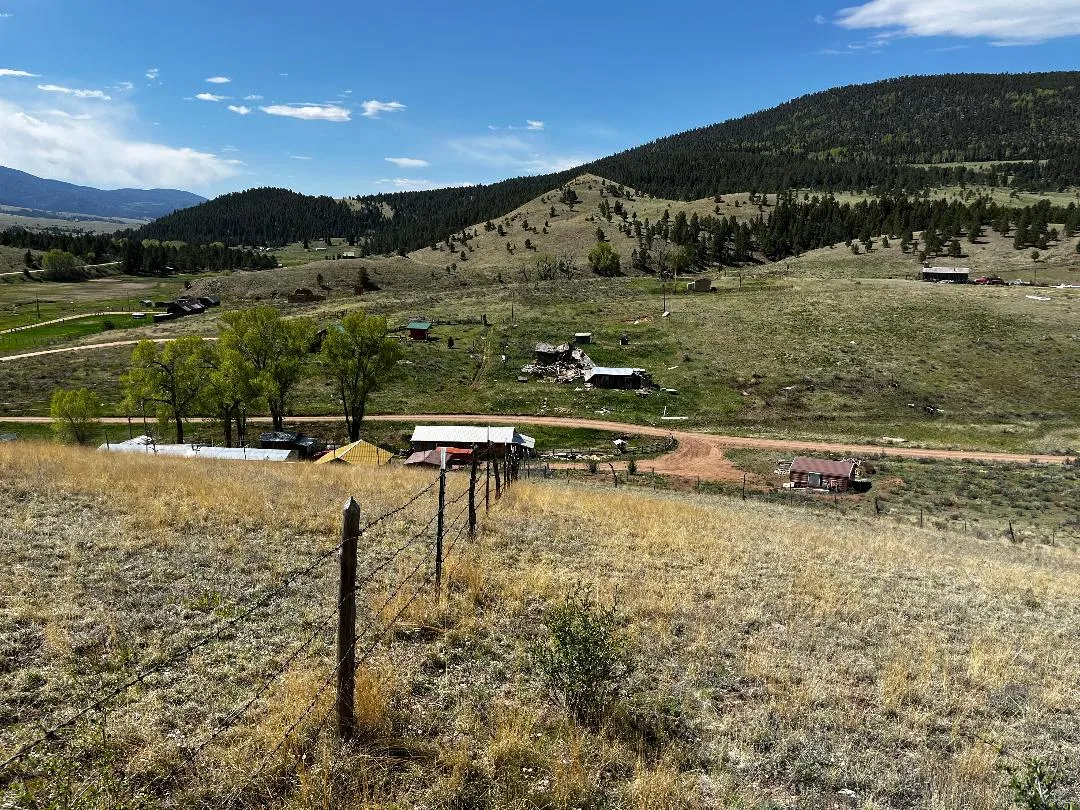
Did you know that long before tour buses and ski traffic rolled through the Moreno Valley, the valley's lifeline was a stagecoach, and the fare was steep? In the gold-rush years, Elizabethtown, five miles north of today's Eagle Nest on State Road 38, was a booming mining camp far from any railroad. Mail, money, supplies, and newcomers all had to reach it the slow way, by horse-drawn coach over mountain roads, and two stage lines, a generation apart, kept the valley connected to the world outside.
Click to see more photos of Elizabethtown — the former gold-rush town the Moreno Valley stage lines served
The first was Colonel Valentine "Jim" S. Shelby's Moreno Valley Stage and Freight Line, started in 1868. It ran three times a week between Maxwell's Ranch, at today's Cimarron, and Elizabethtown, setting out from Maxwell's one day and returning from Elizabethtown the next. A seat cost eight dollars each way, real money in 1868, and the line carried freight as well as passengers, hauling the goods a gold camp could not produce for itself up into the valley and carrying the camp's business back down.
Shelby himself was the kind of character the mining frontier seemed to manufacture. A former army wagon master, he was also a co-owner of the Aztec Mine on Baldy Mountain, and he helped fund the great ditch project meant to bring Red River water to the Baldy Mountain diggings, then took that troubled project over himself when it fell short, gambling that he could find a buyer for it, which he did. He eventually left the Elizabethtown country and ended up in Santa Fe, where he ran a large gambling resort, another service in high demand in New Mexico Territory.
While Shelby's coaches were running, the valley's stage centre was Cimarron, on the Mountain Branch of the Santa Fe Trail. There the Barlow and Sanderson stage station served as the local stage office from 1870 until the mail route closed in 1880, when the railroad reached Springer, some twenty-five miles to the east. The railroad did not end the stage era in the Moreno Valley, though. It simply moved the valley's front door, from the trail town of Cimarron to the rail town of Springer, and the coaches rolled on to meet the trains.
On May 1, 1894, the stagecoach came to Elizabethtown again in earnest: the Springer and Moreno Valley Stage Line began daily passenger runs between Elizabethtown and Springer, where travellers could connect with the railroad. The fare was five dollars, and even so demand was so high that the line was soon running double headers every other day. It carried more than people, too, holding contracts with Wells Fargo Express and the United States Post Office. The route proved so lucrative that H. H. Hankins soon set up a rival on the same road, the Moreno Valley Stage and Freight Company.
Those stage lines are the forgotten first chapter of tourism in this valley. Long before Eagle Nest existed, they were already bringing the outside world up into the Moreno Valley, miners and merchants first, and mail and express packages that tied a remote gold camp to banks, suppliers, and families far away. Today travellers drive the valley and canyon roads those coaches used on paved highways, in comfort the stage passengers could only dream of. In Shelby's day the trip was a swaying coach ride, eight dollars a seat, and worth every cent to a town at the end of the road.