
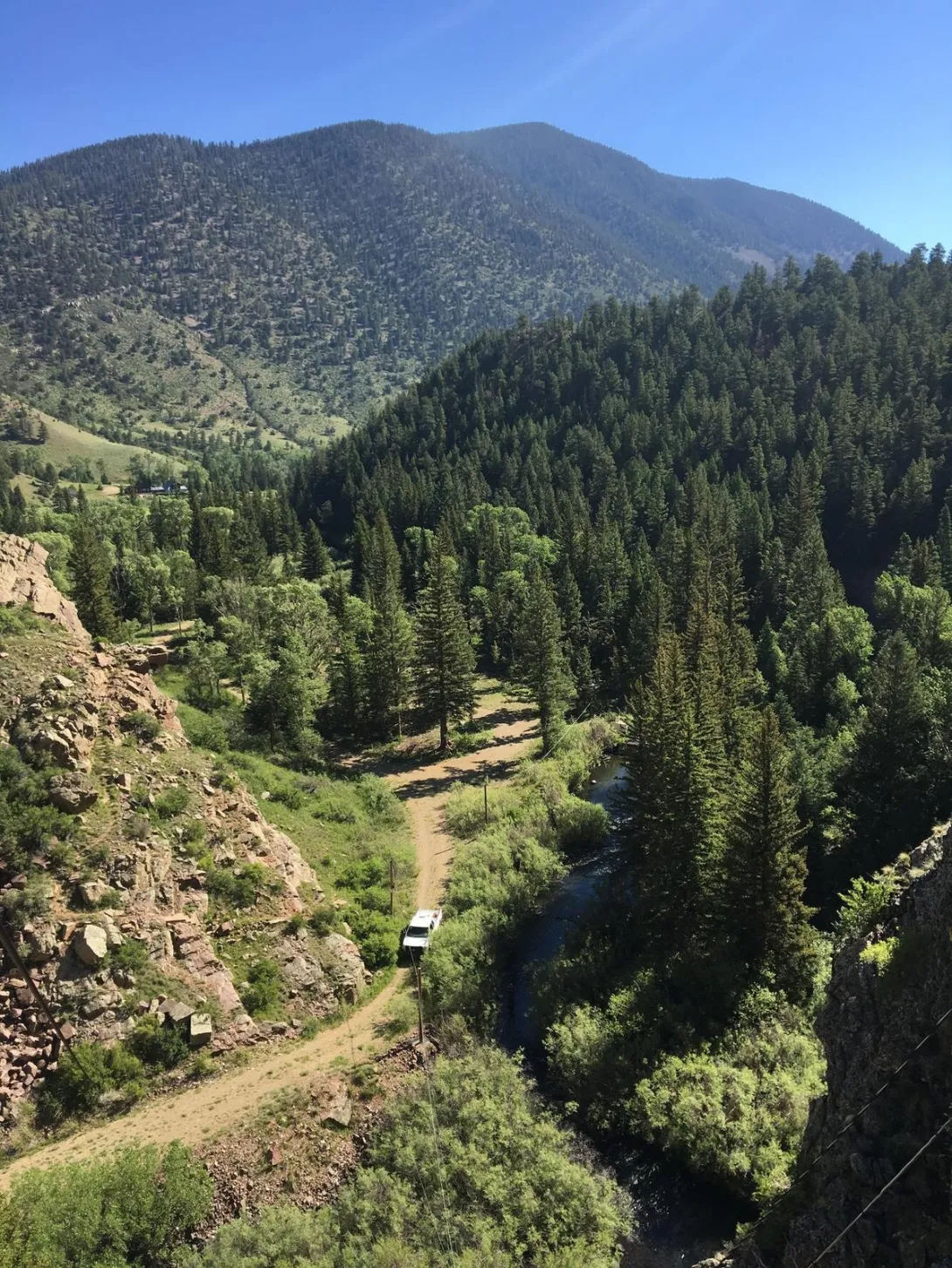
Drive east out of Eagle Nest on U.S. Route 64 and the road soon leaves the wide, grassy Moreno Valley and enters a narrow granite canyon. There, wedged between two rock walls, a pale concrete arch holds back the Cimarron River, and behind it spreads Eagle Nest Lake, five miles of blue water where ranch pasture used to be. Did you know that when it was finished, this was considered the largest privately built dam in the United States? It was no government project. It was the work of two ranching brothers tired of watching spring floodwater rush past dry fields.
Click to see more photos of Eagle Nest Dam and Eagle Nest Lake — including the dam as it looked in 1922
The idea was born on the C.S. Ranch, which Charles and Frank Springer had founded on the banks of the Cimarron River in 1873. In 1907 the Springer brothers and the Cimarron Valley Land Company were granted State Engineer Permit No. 71, allowing them to store the surplus and flood flows of the Cimarron for irrigation. Then came a long wait. Investors were scarce, and nearly a decade passed before the Springers could hire the San Antonio engineering firm of Bartlett and Ranney to design and build the dam, with Willis Ranney as chief engineer and Neal Hanson as construction superintendent. The prize they were chasing was water for more than 40,000 acres of farmland in eastern Colfax County.
Before the dam could rise, two other jobs came first. Beginning in late 1916, about 150 men worked on an eight-mile project: cutting a railroad tunnel through the rock above the dam site, and rerouting the canyon road from Ute Park toward Elizabethtown and Taos around the construction site. Major work began in early 1918. A temporary town housed several hundred laborers from across the state, including workers from Taos Pueblo, supplies were hauled in through Cimarron, and a sixty-foot overhead trestle lifted cement into place. By 1919 the structure was rising above the water, but severe winter freezes in 1919 and 1920 halted cement work for much of the year, and World War I brought shortages of labor and materials. The final phases were completed in late 1920.
The finished arch is a study in lean engineering. It stands 140 feet above the river bed and curves 400 feet between the granite walls, yet it is only 9.5 feet thick at the crest, widening to 45.2 feet at the base, leaning its weight into the canyon rock. Behind it, Eagle Nest Lake covers about 2,500 acres, measures five miles long and two miles wide, and sits at 8,172 feet above sea level when full, holding some 79,120 acre-feet of water. Local tradition says the name came from the eagles that nested on the sides of the new dam. The road, meanwhile, was rerouted over McAvoy Hill, where U.S. Route 64 still climbs today.
More than a century later, the dam is still doing the job it was built for. It was added to the National Register of Historic Places on April 18, 1979, as one of the oldest functioning arch-type dams in New Mexico. The State of New Mexico purchased the reservoir in 2002, and today the Interstate Stream Commission operates it, delivering roughly 16,000 acre-feet of water a year to farms, ranches, and towns. The lake the brothers imagined as an irrigation bank became something more: the heart of a fishing and recreation valley, and the reason the little town of Eagle Nest, first settled as Therma in 1920, grew up on its shore.