
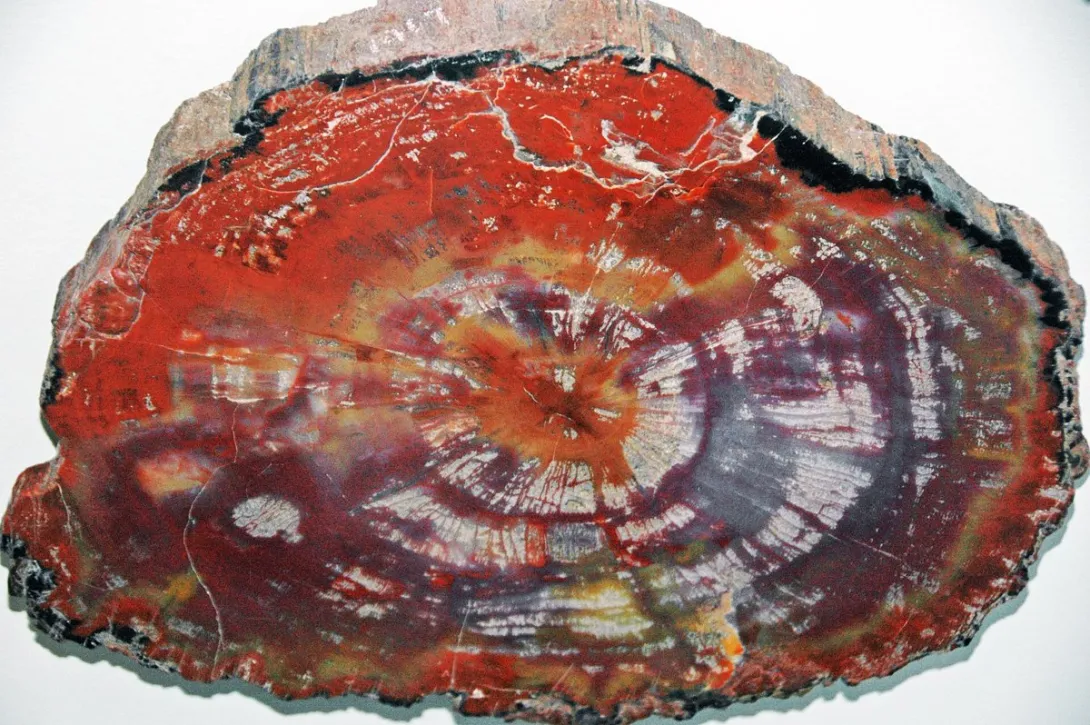
Around Eagle Nest, a walk along a gravel bar or a look through a rock shop bin can turn up a curious puzzle: a piece that looks exactly like wood, with grain and rings, but feels cold, hard, and heavy in the hand. That is petrified wood, and learning to recognize it is one of the most satisfying skills a beginning rockhound can pick up in the Moreno Valley.
Click to see more photos of petrified wood
Petrified wood begins as a real tree. When a trunk or branch is buried quickly in wet sediment or volcanic ash, the lack of oxygen slows decay. Groundwater carrying dissolved silica then moves through the wood, and silica in the form of opal, chalcedony, or quartz fills the pore spaces and replaces the cell walls. Because that replacement can preserve fine detail, growth rings, grain, and even bark texture often survive in stone long after the original wood is gone.
New Mexico is well suited to that story. Research summarized by the New Mexico Geological Society notes that fossil wood is known from New Mexico rocks ranging from the Pennsylvanian through the Quaternary, and that silicification and calcification are the two most common ways wood petrifies here. Silica often came from volcanic material, which dissolved in groundwater and then hardened again inside the buried wood. In the Moreno Valley, later erosion, stream action, and the late Pliocene to early Pleistocene gravels described by the New Mexico Bureau of Geology have reworked older material across the valley floor, which is why an identification eye matters more than any single spot.
In the hand, petrified wood gives itself away in a few reliable ways. Look first for wood structure: parallel grain, concentric growth rings on a cut end, or a rough outer surface that resembles bark. Then check the feel. A true piece is stone, noticeably heavier than a dry piece of wood of the same size, and it will not flex, smell of resin, or show fresh fibers. Its colors often come from trace minerals, with iron producing the familiar reds, oranges, and yellows and manganese adding darker tones. A polished face may show quartz-like luster, while a broken edge tends to look dense and fine-grained rather than splintery.
That combination also helps separate petrified wood from its close cousins. Plain jasper can share the same reds and yellows, and agate can share the same silica, but neither normally preserves clear wood grain and rings through the whole piece. If the pattern runs like wood from end to end, and the weight and hardness match stone, you are most likely holding a small piece of an ancient forest, preserved by water, ash, and time.
Know before you go
Collect only where legal, and never assume a gravel bar or roadside is open ground. Much of the Moreno Valley is private ranch land, and collecting there requires landowner permission. On Bureau of Land Management land, petrified wood for personal use is limited to twenty-five pounds plus one piece per day and no more than two hundred fifty pounds in a calendar year, with no sale or barter and no pooling of quotas for a larger piece. Collecting is prohibited on a mining claim without the claim holder's permission, and state parks and other protected areas are look-and-learn only. Use hand tools only where collecting is allowed, keep any disturbance minor, never enter old mine workings, and pack out what you pack in.