Every lake has a fish that tells its season, and at Eagle Nest Lake that fish is the kokanee salmon. Kokanee are landlocked sockeye salmon: they never travel to the ocean, and they live out their entire lives in fresh water. That makes this high lake, more than 2,200 acres when full, a natural home for them. The New Mexico Department of Wildlife notes that kokanee thrive in some of New Mexico's deeper and colder plankton-producing lakes, and our cold, high water in the Moreno Valley has made them, along with rainbow trout, one of the two fisheries this lake is primarily managed for.
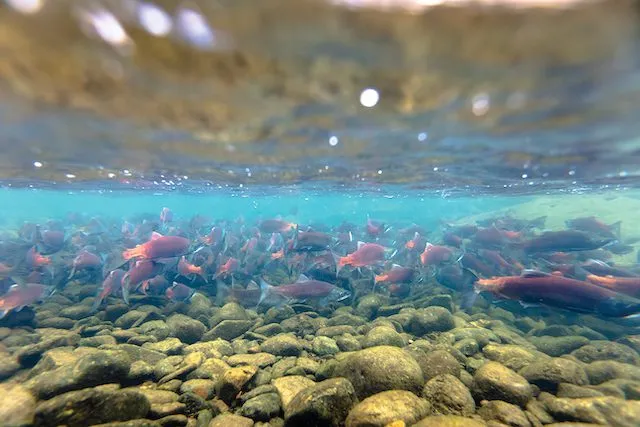
For most of the year kokanee travel the open water in schools, feeding on plankton over the deepest parts of the lake. Then, in late fall, large schools of four-year-old fish gather to spawn, and die. It is the same ending their ocean-going sockeye relatives meet after a far longer journey, played out here along our own shores and inlets. The fish that gather this fall are completing a cycle that began when they were stocked as tiny fry, grew for years in the cold depths, and now give their eggs to the gravel before their lives end.
That fall gathering created one of New Mexico's most unusual fishing traditions. Kokanee are the only fish that may be legally snagged in the state, and only during the special kokanee snagging season. Snagging means taking a fish by hooking its body rather than its mouth, a method reserved for these spawning salmon. At Eagle Nest Lake the season runs from October 1 through December 31, so as you read this, that season is under way on our water, and anglers are sharing the shoreline with a tradition far older than the park itself.
Keeping that story going takes work. The kokanee fishery here is maintained with annual stockings of fry, and recent years were lean: from 2022 through 2025, fewer than 100,000 kokanee were stocked each year, after low spawner returns and disruptions to field spawning and hatchery work during the COVID-19 pandemic. In 2026 the number rose again to 300,000 fry, near the average stocked since 2010. Each autumn the department also collects kokanee eggs to hatch fry for future stocking, and beginning this autumn it plans to conduct spawning operations right here at Eagle Nest Lake to increase statewide egg collection.
The fish themselves suggest the lake still grows them well. Kokanee caught in the department's autumn 2025 survey averaged 18.2 inches, and those in its summer 2026 survey averaged 20.2 inches, sizes the department describes as large compared with other lakes in New Mexico. So if you stand on our shore this fall and watch the water, know that beneath the surface a whole generation of kokanee is turning toward its final, ancient errand, and that the next generation is already being gathered for. That is fishing heritage, still alive at Eagle Nest Lake.