As autumn deepens in the Moreno Valley, bald eagles begin showing up over Eagle Nest Lake again. The first arrivals appear in late fall, and their numbers build through the cold months, with December and January usually the best time to see them. For a town and a lake that carry the eagle name, it is a fitting homecoming: few places in New Mexico offer an easier setting for watching these birds at work.
Click to see more photos of bald eagles
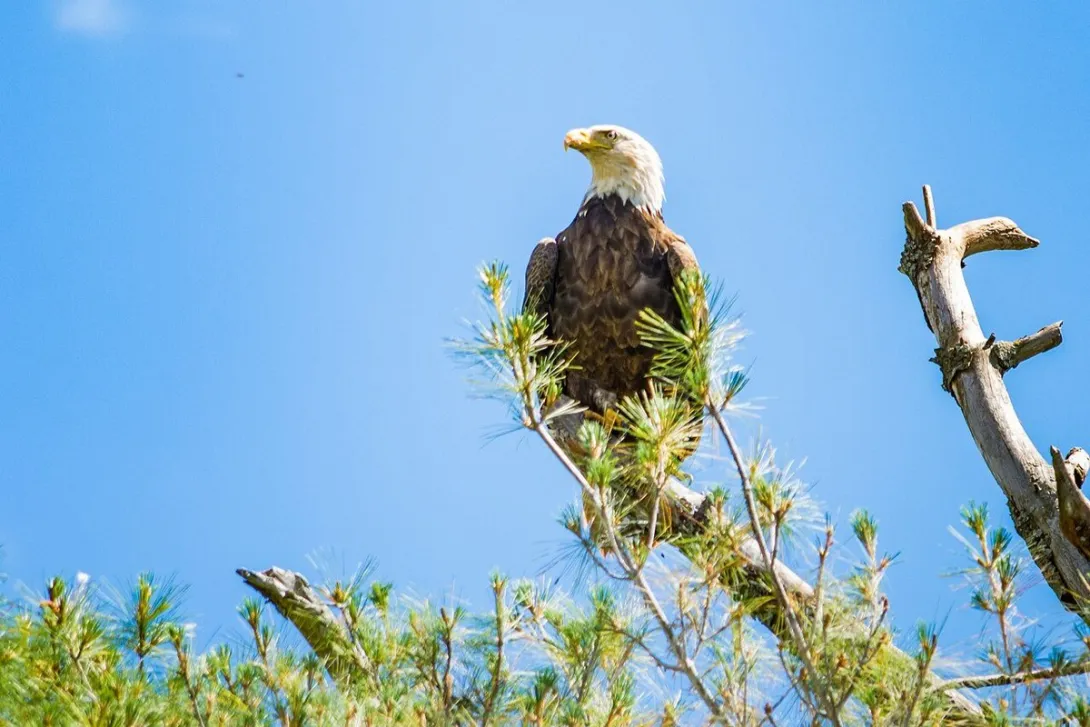
An adult bald eagle is hard to mistake. It carries a bright white head and tail, a dark brown body and wings, and a heavy yellow bill, and it can span more than six feet from wingtip to wingtip. Young birds are trickier. Juveniles wear mottled brown plumage and only gradually trade it for the classic white head over their first several years, so a big brown raptor over the lake in winter may well be a young bald eagle rather than a golden eagle, though golden eagles winter here too. Bald eagles feed mainly on fish, and Eagle Nest Lake gives them plenty to hunt: the lake is regularly stocked with trout and salmon and also holds northern pike and yellow perch.
Watching for them is a patient, pleasant pastime. Scan the shoreline trees and snags around the lake, where eagles perch to survey the water, and watch the open water itself for a bird swooping low to snatch a fish. Cold mornings are often productive, and binoculars or a spotting scope turn a distant speck into a clear view without crowding the bird. The lake sits at about 8,200 feet in the Moreno Valley, ringed by high peaks including Wheeler Peak, so even a quiet morning of looking comes with a fine view. As winter tightens and ice spreads across the lake, eagles tend to concentrate where open water remains, and the osprey that dive for fish here in the warmer months give way to their larger winter counterparts.
Know before you go
Watch eagles ethically and give them plenty of room. Keep your distance and enjoy them through binoculars rather than approaching for a closer look, never feed wildlife, and stay on roads, shorelines, and established trails. Exact locations of sensitive spots such as roosts are intentionally not shared here, so the birds can rest and hunt undisturbed. Dress warmly for high-country winter mornings, check current park alerts before you go, and let the eagles set the terms of the encounter.